
QSE Certifications
Nowadays, it is essential for businesses to comply with high standards in health, safety, and environmental responsibility. Occupational health and safety are becoming central to business ethics, driving demand for international compliance. These standards, integrated into a Quality Safety Environment (QSE) approach, demonstrate companies' commitment to excellence and open access to international markets. In this article, we will discover why QSE certifications, and more specifically ISO certifications, are becoming a strategic pillar for companies seeking to strengthen their competitiveness.
What is an ISO certification?
An ISO certification is a procedure by which a third party provides written assurance that a process, product, or service meets the requirements of a given standard. Today, these standards are published by the International Organization for Standardization (ISO). This is a non-governmental organization made up of numerous national standardization bodies. Since 1947, this organization's experts have been developing international standards by pooling their knowledge. Developed with the aim of ensuring reliability, building trust, and simplifying choices, these standards define excellence and serve as a benchmark for businesses and consumers alike.
Which ISO standards are specific to the Quality, Safety, and Environment (QSE) field?
First and foremost, a QSE initiative is characterized by the implementation of an integrated management system based on the ISO 9001 (quality management system), ISO 14001 (environmental management), and ISO 45001 (occupational health and safety) standards, and enables companies to adopt a comprehensive risk management policy.
The ISO 9001 standard: quality management system (QMS)
The ISO 9000 family of standards, which includes some of ISO's best-known standards, was developed to address the various aspects of quality management. ISO 9001 is the most popular standard worldwide, with more than one million companies and organizations certified to it in over 170 countries. ISO 9001 sets out the criteria for a quality management system implemented by an organization, enabling it to provide products and/or services that meet customer requirements. Here are the seven principles of quality management:
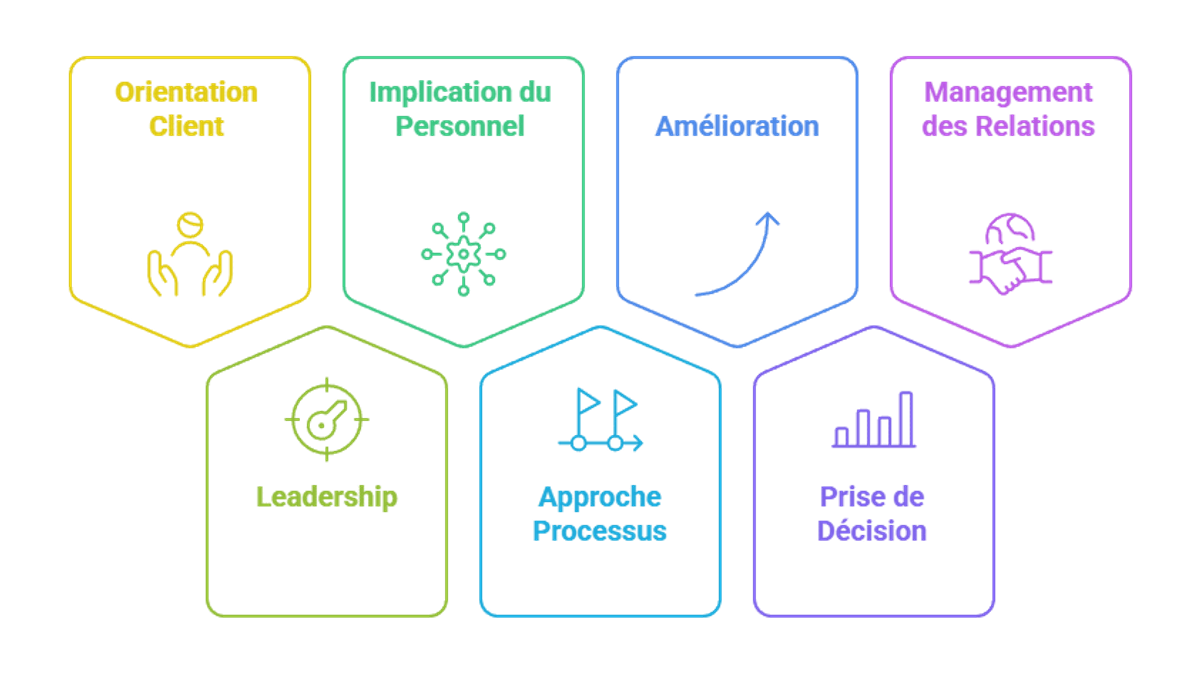
ISO 9001 was first published in 1987 and has been regularly revised since then. Its latest revision dates from 2015.
The ISO 14001 standard (environmental management)
Today, ISO 14001 is a widely recognized benchmark, used by thousands of organizations wishing to take responsibility for the environment. In this sense, ISO 14001 provides a framework defining rules for integrating environmental concerns. It helps control environmental impacts and thus reconcile them with the organization's operational requirements. Meeting its requirements involves implementing an environmental management system that includes:
- An analysis to establish an overview of the organization's activities, the regulations applicable to them, and the environmental impacts they generate.
- A policy including a commitment to continuous improvement with regard to applicable environmental legislation
- The organizational structure, responsibilities, practices, and resources needed to develop, implement, and maintain the organization's environmental policy.
The ISO 45001 standard: Occupational Health and Safety Management (OHS)
According to the International Labour Organization, more than 7,600 people lose their lives every day as a result of a work-related accident or occupational disease. In fact, it is estimated that around 4% of global GDP is lost due to the cost of workplace accidents, deaths, and illnesses! This is why ISO commissioned a committee of experts specializing in occupational health and safety to develop an international standard. It could potentially save nearly three million lives each year. Moreover, this standard offers a single, clear framework for all organizations wishing to improve their performance in occupational health and safety (OHS). Ensuring employee safety and reducing workplace risks is essential to guaranteeing the company's long-term sustainability. This requires an effective risk management system.
According to the International Labour Organization, more than 7,600 people lose their lives every day due to occupational accidents or work-related diseases, underscoring why a robust OHS management system like ISO 45001 is critical.
ISO 45001 requires an organization to:
- Identify hazards and assess risks to occupational health and safety related to its activities and services
- Determine the necessary controls
- Set clear objectives and targets to improve its OHS performance
- Implement systems to demonstrate the company's ongoing commitment to employee health and safety.
The CountAct solution is a way to place the health and safety of employees at the heart of a company's concerns. Indeed, integrating a digital solution in a field such as occupational health and safety allows a company to demonstrate its genuine commitment to protecting its employees. It enables you to rigorously track your occupational health and safety performance indicators. In short, equipping the company with the CountAct solution enables it to trace its actions, an asset that can be leveraged and is highly valued during an audit.
Ready to strengthen your QSE management?
Discover how CountAct helps you place employee health and safety at the heart of your organization while streamlining your path to ISO certification.
What is the benefit for a company of holding ISO certifications?
Obtaining an ISO certification represents a guarantee of trust and recognition. Indeed, this certification provides access to certain markets. It sets you apart from your competitors and attests to the quality of your products, services, and expertise. As a result, all your customers, partners, and investors feel reassured and confident.
What types of companies can obtain ISO certifications?
ISO certification is aimed at all types of companies: from micro-enterprises to large groups, including SMEs. It is objective proof that the product/service provided meets specific requirements and is regularly subject to audits. It is a genuine guarantee of quality.
How long are ISO certifications valid?
Certification is valid for 3 years. After this period, the company must renew its accreditation by undergoing a quality audit conducted by a certification body. We recommend regular internal audits to maintain ISO compliance and continuously improve performance and efficiency. In summary, ISO certifications represent far more than a simple accreditation. Indeed, they embody a concrete commitment to high ethical standards, bringing trust and recognition in competitive markets. By adopting these certifications, companies commit to a path of continuous improvement. They demonstrate their commitment to quality, safety, and the environment.
SécuQuiz
Test your knowledge
Question 1 sur 5
What does QSE stand for in the context of this article?
Sources & references
- driving demand — www.inrs.fr
- International Organization for Standardization (ISO) — www.iso.org
- QSE initiative — bigmedia.bpifrance.fr
Frequently asked questions
Tom BasinStrategic Partnerships Manager
Holding a Master's degree in risk prevention, Tom Basin serves as Partnerships Manager at CountAct, contributing to the development and rollout of the first turnkey crisis management support solution, with the aim of putting security back at the heart of businesses. His experience, along with his training at the Master's level and at the Institut national des hautes études de la sécurité et de la justice, gives him a broad perspective on security and crisis management.