
Post-Exercise Review After a PPMS or Evacuation Drill: How to Turn It Into Progress
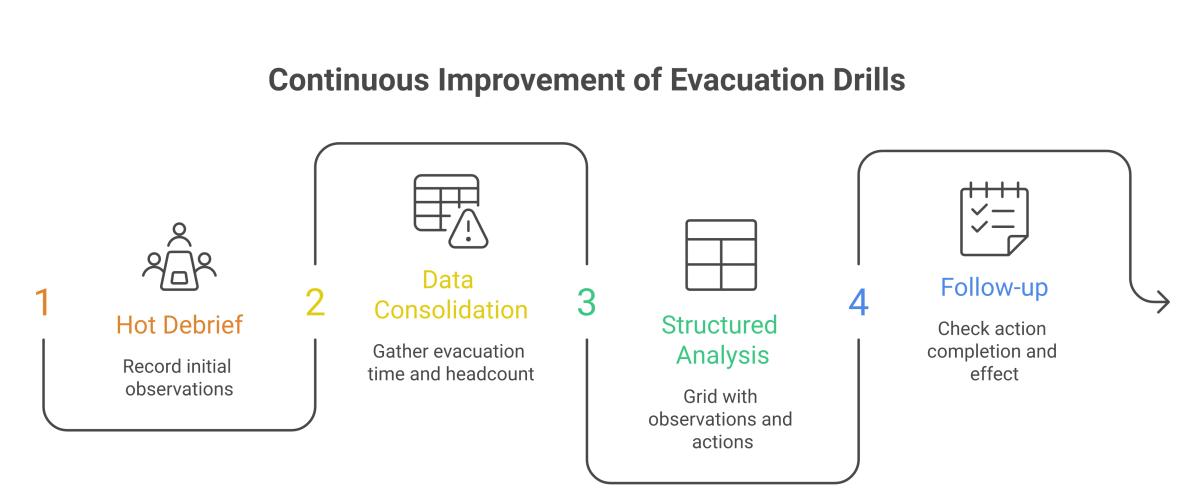
A PPMS drill or an evacuation exercise that ends without a post-exercise review closes off an opportunity to improve: the same bottlenecks will resurface at the next drill. A post-exercise review (RETEX) turns a one-off exercise into measurable continuous improvement by collecting data during the drill, analyzing the gaps between the planned scenario and what actually happened, then formalizing corrective actions that are tracked over time. Here is the 4-step method to make the most of it.
Article L.4121-1 of the French Labor Code requires employers to continuously adapt their prevention measures. A PPMS drill or evacuation exercise without a documented post-exercise review does not demonstrate this continuous adaptation in the event of an inspection or an incident.
Why the post-exercise review is where the real value lies
The drill itself is only a trigger. Successfully running your evacuation drill sets the stage, but it is the after-the-fact analysis that produces improvement: identifying the floor marshals who did not reach the assembly point in time, the zones where the alarm was not heard, the people missed during the headcount. Without this step, each drill remains an isolated snapshot rather than a trajectory of progress.
A single drill gives a snapshot at one point in time: a late floor marshal, an alarm that was hard to hear. Repeated drill after drill, a structured post-exercise review reveals trends invisible to the naked eye, for example the same assembly point that is consistently too far away, or the same zone where the sound device stays undersized despite previous fixes. It is this long-term view that separates a compliance exercise from a genuine continuous improvement approach.
When to hold the review and with whom
Two moments are needed. The hot debrief takes place within the hour following the drill, while observations are still fresh: it brings together the drill leader, floor marshals and rear marshals, and a representative of the crisis unit. The cold review takes place within 1 to 2 weeks, once the data has been consolidated: it also involves the safety manager and draws on the initial drill scenario to compare what actually happened against the starting assumptions.
The cold review agenda generally follows three stages: reporting the quantitative indicators, discussing the on-the-ground observations raised by floor marshals and rear marshals, then collectively agreeing on corrective actions and their deadlines. This meeting should not exceed 45 minutes to an hour to stay productive.
Indicators to collect during the drill
For a PPMS drill, these indicators complement those defined in the site PPMS and build on the different types of PPMS alarms triggered during the exercise:
- Total evacuation time and time per zone or floor, compared to the target time
- Gap between the headcount recorded and the actual number of people on site
- Delay between the alarm being triggered and the start of the evacuation movement
- Bottlenecks identified (doors, walking routes, signage)
- Instructions not followed by occupants
- Technical anomalies (alarm system, emergency lighting, firefighting equipment)
These indicators only become meaningful when compared over time: a drill run once or twice a year can only objectively show a trend if each edition measures exactly the same elements, in the same way.
These indicators are hard to use if they stay scattered across a paper attendance sheet, verbal feedback and an Excel log. EvacApp centralizes evacuation management building by building, floor by floor, and automatically keeps the data needed for the review.

Manage evacuation in real time
EvacApp centralizes evacuation piloting building by building, floor by floor, and keeps the data your next post-exercise review needs.
Structuring the analysis so the debrief meeting does not go in circles
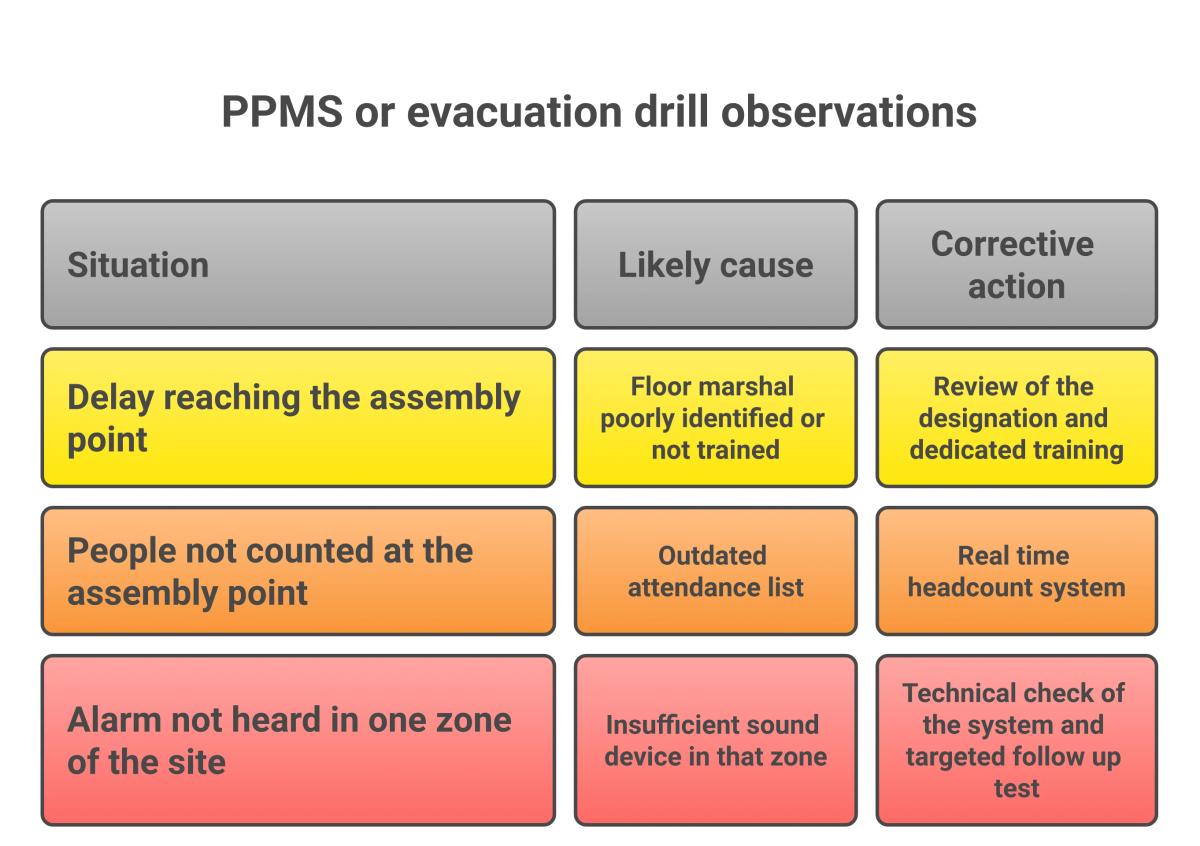
A simple analysis grid keeps a debrief meeting from going in circles: for each point raised, note the observation, the likely cause, the corrective action, an owner and a deadline. This structure turns an informal discussion into a trackable action plan.
A concrete example of a review grid
Here is how this grid applies to one of the most frequent observations raised during an evacuation drill:
- Observation: the 2nd floor marshal reaches the assembly point 4 minutes later than the target time.
- Likely cause: they had not been informed of their role before the alarm was triggered.
- Corrective action: appoint a lead floor marshal and a backup for each floor, trained ahead of the next drill.
- Owner: the site safety manager.
- Deadline: before the next drill, within 3 months.
Formalizing and using the review over time
A post-exercise review is only useful if it does not stay locked inside the last drill's report. Its value comes from comparing one drill to the next: do the same bottlenecks keep resurfacing? Were the corrective actions actually completed?
Post-exercise review on a shared spreadsheet vs. a tracked, tooled review
| Notre solution | Alternative | |
|---|---|---|
| Memory from one drill to the next | Centralized history, comparable drill after drill | Scattered files, memory depends on who was present |
| Tracking corrective actions | Action plan assigned with a deadline and status | Actions noted, then forgotten |
| Documented proof for the safety commission or insurer | Automatically generated report | Manual, incomplete reconstruction |
| Time to prepare the next review | A few minutes, data already collected | Starts from zero every drill |
Where does your PPMS stand?
Assess your PPMS maturity in 3 minutes before your next drill and its post-exercise review.
Observations that keep recurring from one drill to the next, such as a poorly located assembly point or a zone where the alarm is not heard, should also be reported in the site's DUERP, which must continuously reflect the site's actual risks. This record is worth keeping alongside the site's safety register, which already tracks the other fire safety compliance obligations.
The exact content to include in the safety register or the PPMS file depends on your organization's category and its supervising authority. Check with your safety commission, your PPMS officer or your insurer to confirm the expected format for your case.
Sources & references
- Article L.4121-1 of the French Labor Code — www.legifrance.gouv.fr
- Evacuation, intervention: fire safety instructions — www.inrs.fr
- Circular on the school safety and security plan (PPMS) — www.education.gouv.fr
Frequently asked questions
Tom BasinStrategic Partnerships Manager
Holding a Master's degree in risk prevention, Tom Basin serves as Partnerships Manager at CountAct, contributing to the development and rollout of the first turnkey crisis management support solution, with the aim of putting security back at the heart of businesses. His experience, along with his training at the Master's level and at the Institut national des hautes études de la sécurité et de la justice, gives him a broad perspective on security and crisis management.