
Type M ERP (Shops and Shopping Centres): Which Fire Safety Obligations Apply?
When does a shop fall under type M?
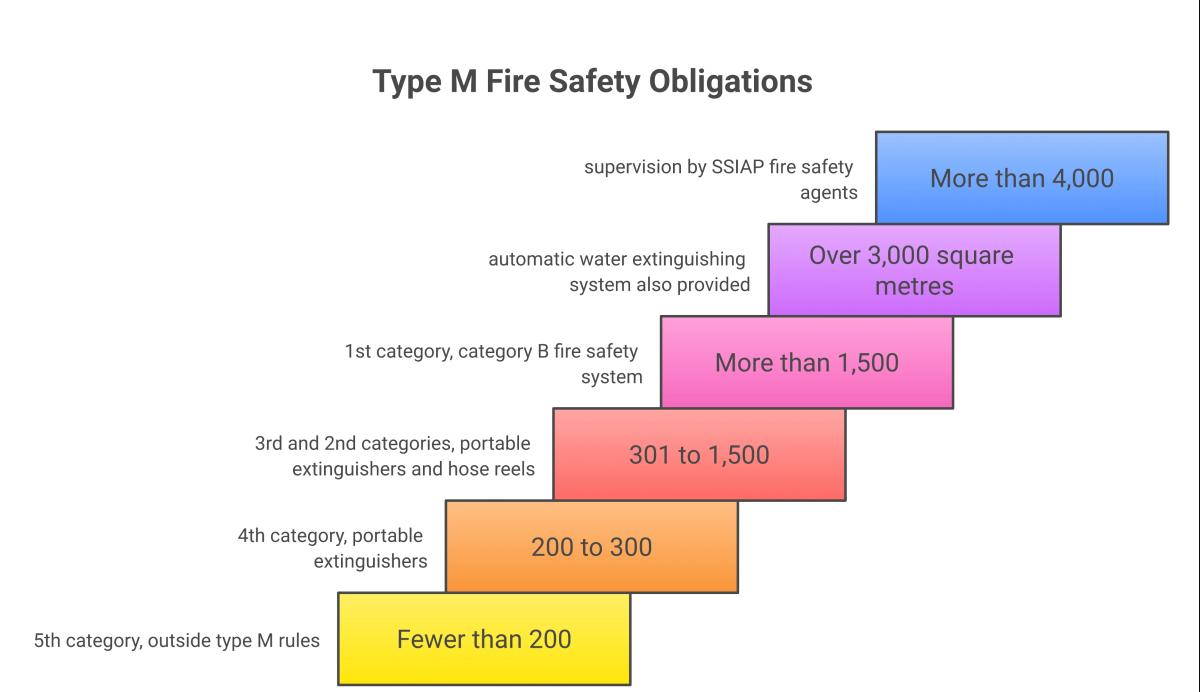
Type M covers retail shops, sales areas and shopping centres. Under article M 1, the regulation applies when the public headcount reaches 100 people in basements, upper floors or galleries, or 200 people in total. Below these thresholds, the establishment falls under 5th category and the provisions for small establishments.
A shopping centre is a group of shops, sometimes together with other public-access establishments, that rely on enclosed malls for access and evacuation. Sales areas exposed to the weather are treated as open-air areas.
Do not mix up the types: a restaurant falls under type N and a hotel under type O. A mixed-use establishment may be concerned by several types at once.
Type M targets retail activity. Only an inspection body, the fire service prevention unit or the safety commission can confirm your establishment's exact classification, especially if it combines retail, catering or services.
Calculating occupancy to find the category
Article M 2 sets a theoretical headcount from the sales area open to the public: one person per 3 m² in the basement, ground floor and first floor, one per 6 m² on the second floor and one per 15 m² on higher floors.
Specific rules apply to shopping centres: malls count one person per 5 m² of area, and shops under 300 m² count one person per 6 m² on every level. The safety commission may accept lower densities on a justified request from the operator.
The resulting headcount determines the category, using thresholds shared by all ERP: 1st category above 1,500 people, 2nd category from 701 to 1,500, 3rd category from 301 to 700, 4th category up to 300 people (above the 5th category threshold). Our article on ERP categories explains what changes from one category to the next.
An underestimated headcount leads to insufficient safety equipment, an overestimated one to heavier equipment than necessary. Have your calculation validated by a professional before sizing your equipment.
Extinguishers, hose reels and automatic water extinguishing
Article M 26 scales the extinguishing equipment by category and area. In 4th category, portable extinguishers are enough. In 1st, 2nd and 3rd categories, with sales areas of 3,000 m² or less, the text adds hose reels (RIA) of DN 19/6 or 25/8, positioned so that two hose jets cover the whole area.
Above 3,000 m² of sales area, excluding open-air sales areas, the text also provides for an automatic water extinguishing system suited to the risks (articles M 26 and M 27), most often a sprinkler network.
Portable extinguishers follow the general logic of article MS 39: distribution according to risks, notably electrical ones. To choose the right equipment for each zone, read our guide on workplace fire extinguishers.
Track the checks of every shop
CompliAssist (Property Security) centralises the ERP obligations of your sites, the verification dates of extinguishers, hose reels and smoke extraction, and calculates your ScoreRisk: the documented proof to present to the safety commission.
Smoke extraction in sales areas and malls
Articles M 18 and M 19 deal with smoke extraction. Malls are smoke-vented like premises of more than 1,000 m², following technical instruction 246. Shops under 300 m² (including adjoining storage) that open onto a mall do not have to be smoke-vented, and no cantonment screen is required between them and the mall.
In multi-level shops with connected levels, the levels may be treated as a single volume of more than 1,000 m². For multi-level malls, the regulation provides for division into cantons of at most 60 m in length.
Extraction areas and flow rates are calculated according to the technical instruction. Entrust the sizing to an engineering office or a qualified smoke extraction contractor, and keep their reports in your safety register.
Alarm, alert and fire safety system
Article M 32 requires alarm equipment whose type depends on the category: type 2a in 1st category, 2b in 2nd, 3 in 3rd and 4 in 4th. In shopping centres, manual call points and sounders are mandatory in the mall and in any unit whose area open to the public exceeds 300 m². If a public address system exists, it must be able to broadcast the alarm.
Article M 30 sets the category of the fire safety system (SSI): category B in 1st category, categories C, D or E in 2nd category. Article M 33 requires a means of contacting the fire service that complies with article MS 70. Finally, article M 31 provides for an overall safety organisation diagram, attached to the safety register, which sets out priority actions and general evacuation arrangements.
Safety service: when are SSIAP agents required?
Under article M 29, up to 4,000 people, safety is ensured by agents appointed by the operator and trained in handling rescue equipment and in evacuation. Above 4,000 people, supervision is entrusted to fire safety agents (SSIAP).
For shopping centres, the number of agents rises with the theoretical public: 3 agents including one SSIAP 2 from 4,001 to 6,000 people, 4 agents from 6,001 to 9,000, and so on. Above 9,000 people, the service is headed by an SSIAP 3 service manager.
The SSIAP staffing levels of article M 29 apply to the theoretical public of the shopping centre. Have the safety commission or your inspection body confirm what applies to your establishment.
Proving compliance: register, inspections and traceability
The operator must be able to present an up-to-date safety register during safety commission visits. For a network of shops, paper or spreadsheet tracking quickly reaches its limits, as our article on multi-site safety registers explains. According to CountAct client feedback, 1 obligation out of 4 is missed or poorly documented with Excel tracking.
You deserve better than Excel and WhatsApp. CompliAssist (Property Security) traces compliance checks and deadlines. On the People Security side, EvacApp steers evacuation floor by floor and LiveCount counts the people present in real time, so that no one is left behind during an evacuation.
Shop fire compliance: two ways to prepare
| Traced tracking (up-to-date register, ScoreRisk) | Isolated paper or spreadsheet tracking | |
|---|---|---|
| Safety commission visit | File available immediately, dated history | Documents searched under pressure, risk of an unfavourable opinion |
| Checks of extinguishers, hose reels and smoke extraction | Deadlines tracked and reports centralised | Forgotten dates, reports scattered across contractors |
| Headcount and category calculation | Assumptions and validation kept on record | Calculation redone at each visit, no trace |
| Network of several shops | Consolidated view per site | One file per shop, no overview |
SécuQuiz
Test your knowledge of fire safety in type M shops
Question 1 sur 4
From what total headcount does a shop fall under type M, according to article M 1?
Sources & references
Frequently asked questions
Tom BasinStrategic Partnerships Manager
Holding a Master's degree in risk prevention, Tom Basin serves as Partnerships Manager at CountAct, contributing to the development and rollout of the first turnkey crisis management support solution, with the aim of putting security back at the heart of businesses. His experience, along with his training at the Master's level and at the Institut national des hautes études de la sécurité et de la justice, gives him a broad perspective on security and crisis management.