
Occupational health service
- What are occupational health services?
- What are their roles?
- How do I find my Occupational Health Service?
- Who should I contact in case of suffering at work?
- Why does occupational health and safety represent a human issue?
- How to set up an OHS?
- My doctor refuses to extend my sick leave, what should I do?
- Occupational health services and other prevention stakeholders
What are occupational health services?
Today, there are 2 types of Occupational Health Service. Indeed, this often depends on the size of the company. It can be autonomous (SPSTA) if the company has the means to internalize it. Otherwise, it is inter-company and therefore shared by several companies, often called SPSTI. Obviously, it is intended for all employees. Also, it is MANDATORY and organized from a material and financial standpoint by the employer. It is overseen by the DREETS.
What are their roles?
The main mission of occupational health services, also known as SPSTI or occupational health division, is to advise employers and employees to prevent the deterioration of workers' health due to their work. The 4 main missions of these services are as follows:
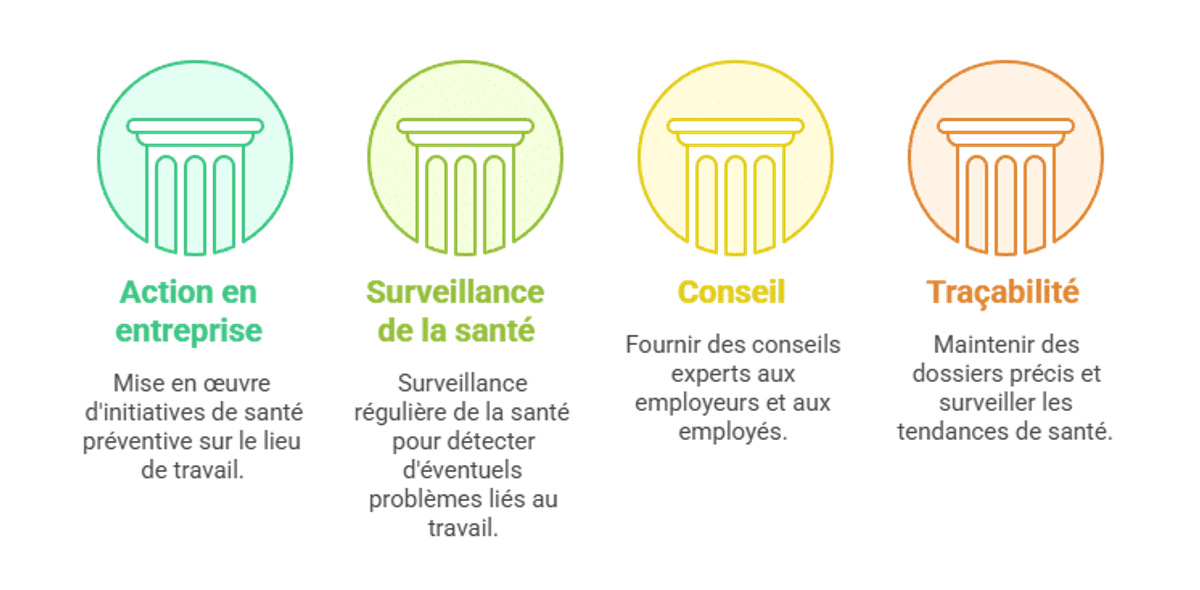
First, the mission carried out by SPSTIs is to conduct a diagnostic to assess the risks that could harm health (thermal, chemical, mechanical, infectious, electrical, etc.). This operation is carried out with the staff in charge of health and safety within the company (CHSCT) or directly with the employer. Next, the occupational physician or prevention physician also has the role of monitoring each employee's state of health through an individual visit before or after the employee is hired. A multidisciplinary team is also formed, linking the diagnosis of the work environment with employees' individual health status in order to propose appropriate prevention measures to safeguard each employee's health. All data is collected in the medical file and the company file, allowing for better follow-up. Thus, the actions of SPSTIs are organized within an overall intervention strategy deployed in the workplace in order to prevent any deterioration of the worker's health.
How do I find my Occupational Health Service?
It is very simple to find your Occupational Health Service or occupational health division. Indeed, you will find its contact details based on the geographic area you are located in relative to the DREETS. You can also find your Occupational Health Service and prevention physician via this link: https://www.presanse.fr/annuaire-medecine-travail/ Also, if you have staff on secondment in other departments, you can join what are known as Local Occupational Health Services.
Who should I contact in case of suffering at work?
In case of suffering at work, as indicated by the DREETS, you should immediately contact your occupational physician. Indeed, it is punishable by law to face a situation of suffering at work without action being taken. So don't wait, and contact your occupational physician or the relevant point of contact within your organization to prevent your health from deteriorating. Indeed, occupational medicine is bound by professional confidentiality and cannot disclose any information about you to anyone.
If you are experiencing suffering at work, don't wait: contact your occupational health service or occupational physician immediately. Early intervention makes it much easier to protect your health and your rights.
Why does occupational health and safety represent a human issue?
Occupational health and safety represents a human issue. Indeed, negligence by companies can cost them dearly. In France, there are no fewer than 1,200 work-related deaths per year (workplace accidents, commuting accidents, occupational illnesses). Thus, by implementing a prevention approach and supporting employees. This makes it possible to have sustainable health and safety standards. The method of prevention and consideration of the human factor initially provides improved working conditions for employees, but also allows them to thrive in their daily tasks. It therefore follows that this will increase productivity. It is important to understand that poor SPSTI management leads to numerous negative impacts on a company, whether human or economic. Indeed, among the harmful effects of poor SPSTI management, there can be early retirements, or even the inability to assess the reliability of human resource capacity (loss of qualified staff, injuries, repeated sick leave, etc.). If you have questions about employee health within companies, atousante can address your query on their blog. Indeed, atousante presents itself as a reference in terms of occupational health division monitoring.
How to set up an OHS?
To help them set up an OHS, companies can implement one through Analysis, the establishment of a prevention action plan, organization, and performance measurement. Indeed, companies can benefit from the advice and expertise of prevention organizations such as Occupational Health Services, CARSAT, or OPPBTP. They can also be supported by an external consulting firm (information programs, action-training, awareness meetings, etc.). You are probably wondering, how often should a medical check-up take place? First of all, it is important to understand that the employer is required to arrange a pre-employment medical examination. This pre-employment medical examination provides the first contact with the occupational health division. Following this, an information and prevention visit with the occupational physician or prevention physician must take place at least every 5 years. If the worker has a disability, holds a disability pension, or works night shifts, then a visit with the occupational physician must be carried out at least every 3 years. However, if an employee must return to work following a leave of at least 30 days, then a request for a pre-return visit can be made by the employee or the treating physician. Of course, this is not mandatory. Also, a return-to-work medical visit is mandatory only if the employee had sick leave of more than 30 days. But also for a work absence of more than 60 days (due to a non-occupational accident or illness), a work absence of 30 days (due to a workplace accident), or maternity leave. Thus, if the employee does not meet any of the reasons mentioned above, then the return-to-work medical visit is not mandatory.
My doctor refuses to extend my sick leave, what should I do?
If your doctor refuses to extend your sick leave, it is possible to contest the decision. This is done through the informal appeals board (CRA). This appeal must be filed within 2 months of the doctor's assessment. Finally, if the informal appeals board issues an unfavorable response to your decision, then it is possible to file an appeal before the social division of the regional court (TGI).
Occupational health services and other prevention stakeholders
Now you know more about occupational health and prevention services. We therefore invite you to read our article on safety stakeholders. This article aims to further your knowledge of the important roles within a company.
Need help setting up or navigating your occupational health service?
Our team can help you understand your obligations, choose the right OHS, and build an effective prevention plan tailored to your company.
SécuQuiz
Test your knowledge
Question 1 sur 5
What are the two types of Occupational Health Services (OHS) mentioned in the article?
Sources & references
- https://www.presanse.fr/annuaire-medecine-travail/ — www.presanse.fr
- 1,200 work-related deaths per year — www.francetvinfo.fr
- information and prevention visit — www.service-public.fr
- carried out at least every 3 years. — www.economie.gouv.fr
- a pre-return visit can be made by the employee — travail-emploi.gouv.fr
- informal appeals board — www.legislation.cnav.fr
Frequently asked questions
Tom BasinStrategic Partnerships Manager
Holding a Master's degree in risk prevention, Tom Basin serves as Partnerships Manager at CountAct, contributing to the development and rollout of the first turnkey crisis management support solution, with the aim of putting security back at the heart of businesses. His experience, along with his training at the Master's level and at the Institut national des hautes études de la sécurité et de la justice, gives him a broad perspective on security and crisis management.