
SSIAP agent in an ERP: who needs one and what presence obligations apply
Is an SSIAP agent mandatory in your public venue (ERP)?
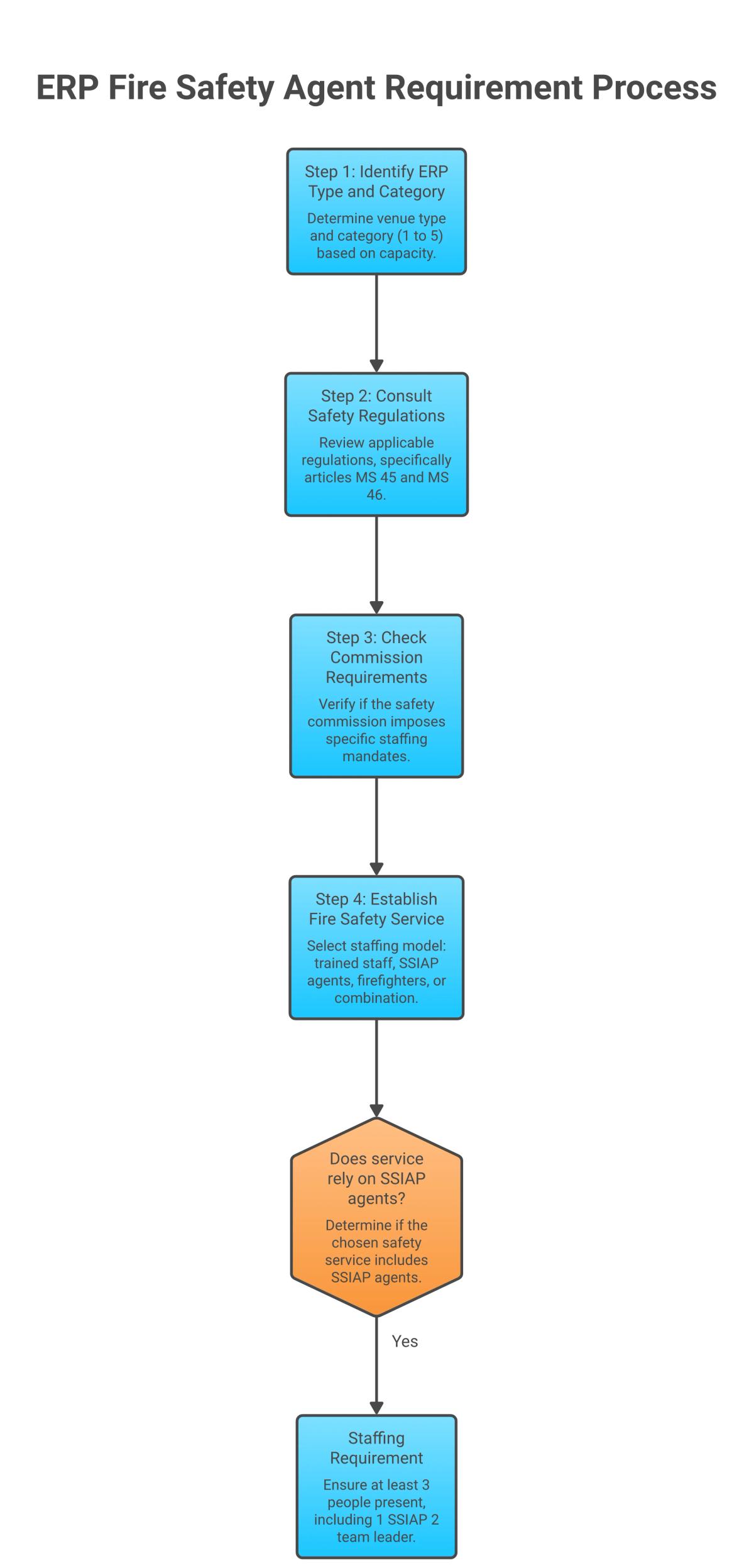
Not systematically. The French ERP safety regulation (order of 25 June 1980) requires a fire safety service while the public is present. That service can take several forms: using SSIAP agents depends on the type and category of the venue, and on the requirements of the safety commission.
SSIAP stands for fire safety and personal assistance service. It is the qualification of the staff (levels 1, 2 and 3). The fire safety service itself is the organisation the operator sets up while the public is received.
What the regulation says: the fire safety service (MS 45 and MS 46)
Articles MS 45 to MS 52 of the order of 25 June 1980 frame the fire safety service. Under article MS 46, while the public is present, the service can be made up of:
- trained staff designated by the operator;
- qualified fire safety agents (SSIAP);
- firefighters;
- or a combination of these, after the opinion of the safety commission.
In an answer published in the Journal officiel on 20 February 2018, the Ministry of the Interior states that this service is mandatory in all ERPs, but that its composition varies with the type, category and characteristics of the venue. Presence and organisation of the service are the operator's responsibility.
When SSIAP agents become necessary
There is no single threshold. Each ERP type has its own specific provisions, which set out when a qualified agent is required. Example given by the ministry: for type L ERPs (audition rooms, conference rooms, meeting rooms, multipurpose halls), article L 14 of the order of 5 February 2007 specifies the activities that require an SSIAP agent.
The category also matters. It depends on occupancy, with category 1 above 1,500 people (article R143-19 of the Construction and Housing Code). Our article on ERP categories 1 to 5 details what each threshold changes. For an example of a specific type, see the fire safety obligations of type M ERPs.
Finally, the safety commission can issue requirements specific to your venue. Prepare for that discussion with our guide to the safety commission process.
Occupancy thresholds vary by ERP type and change with the texts. For your case, check the regulation for your type, then have the staffing of your fire safety service validated by the safety commission, your inspection body or the fire service.
How many people, and what presence?
When the service relies on SSIAP agents, article MS 46 provides for at least three people present at the same time, including a team leader. The team leader and at least one agent must not be diverted from their fire safety duties.
Presence is assessed while the public is received, not only at peak hours. A schedule that leaves an opening slot without a full team is a gap to document, not a detail of organisation.
SSIAP 1, 2 and 3: who does what
The order of 2 May 2005 defines the missions, employment and qualification of permanent fire safety staff in ERPs and high-rise buildings (IGH). Its Annex I distinguishes three levels:
- SSIAP 1, fire safety agent: initial SSIAP 1 training (or SSIAP 2, or a listed equivalent diploma), up-to-date first aid, three-yearly refresher;
- SSIAP 2, team leader: management of the safety team, with agent experience required by the annex (1,607 hours over the last 24 months);
- SSIAP 3, head of service: management of the safety service and advice to the head of the establishment on fire safety, with a level 4 diploma or an SSIAP 2 and three years of experience.
Special case: the agreement for one-off events
Article MS 46 §3 allows the operator to sign an agreement with one or more users to organise the safety service during events or activities. This flexibility only applies to venues other than category 1, without accommodation, fitted with a general alarm that does not require human monitoring, and whose total occupancy does not exceed 300 people.
The agreement must be attached to the safety register. If your hall hosts associations, check these conditions one by one before relying on it.
Proving presence: what the register must be able to show
During an inspection or after an incident, you will not only be asked whether you have agents, but to prove they were there, qualified and up to date. Qualifications, refreshers, schedules, instructions and drills must be retrievable. That is where paper forms and spreadsheets break down: according to CountAct figures, 1 obligation in 4 is missed or poorly documented with Excel tracking.
Tracking the compliance of your safety service
Across several sites, proof of presence and qualification quickly gets lost between files.
| Centralised tracking (CompliAssist) | Excel and paper | |
|---|---|---|
| Qualifications and refresher deadlines | Visible in a single tracker per venue | One file per site, manual updates |
| Safety register and supporting documents | Digital register, traceability kept | Paper binders, scattered copies |
| Multi-site view | Dashboards and automatic reports | Consolidated by hand |

Centralise the tracking of your ERP obligations
CompliAssist (Property Security) tracks your compliance obligations, from keeping the safety register to deadlines per site, and calculates your ScoreRisk.
What this means for a multi-site manager
Two practical habits. One: record for each site its type, category and validated safety service staffing in a single document. Two: recheck that staffing after any change in occupancy, activity or layout, because a venue can change category.
This content presents general obligations and does not replace the advice of an inspection body, the safety commission or a lawyer for your venue.
SécuQuiz
Test your knowledge of the fire safety service
Question 1 sur 3
When must the fire safety service be provided in an ERP?
Sources & references
- Article MS 46 - Order of 25 June 1980 (ERP safety regulation) — Légifrance
- Order of 2 May 2005 on the missions, employment and qualification of permanent fire safety staff in ERPs and IGHs — Légifrance
- Article R143-19 - French Building and Housing Code — Légifrance
- Written question no. 1475 and Ministry of the Interior answer (Official Journal, 20 February 2018) — Assemblée nationale
Frequently asked questions
Tom BasinStrategic Partnerships Manager
Holding a Master's degree in risk prevention, Tom Basin serves as Partnerships Manager at CountAct, contributing to the development and rollout of the first turnkey crisis management support solution, with the aim of putting security back at the heart of businesses. His experience, along with his training at the Master's level and at the Institut national des hautes études de la sécurité et de la justice, gives him a broad perspective on security and crisis management.