
Multi-Site Safety Registers: Why Paper and Spreadsheets Stop Scaling
The safety register: one document per site, compliance to manage across a group
Every French establishment receiving the public (ERP) must keep a safety register, whether it operates a single site or is one of dozens managed by the same group. The obligation itself does not change with scale: it is identical for every establishment. The difficulty starts when you need to track the compliance status of several sites at once without losing sight of any of them.
The safety register stays attached to each establishment: there is no regulatory concept of a single group-wide register for a multi-site organization. What can be shared is how you track and manage it, not the underlying obligation itself.
Why a spreadsheet or paper binder stops working past a handful of sites
A paper register or spreadsheet works fine for a single site. As the number of establishments grows, the same limitations show up every time:
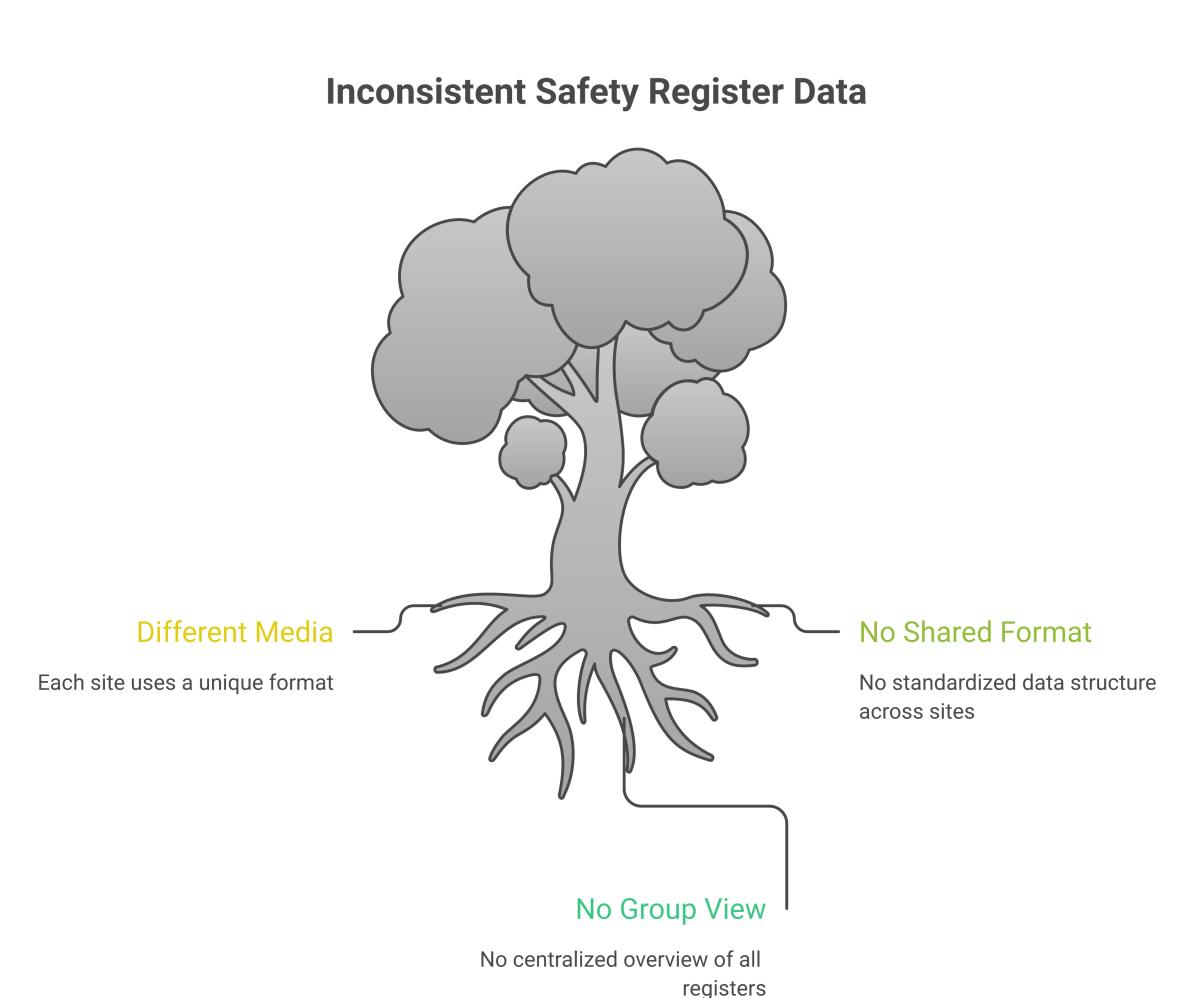
- Inconsistent formats across sites: each local operator keeps their register their own way, in their own binder or file.
- No consolidated view of the compliance level across the whole portfolio of sites.
- Update delays that stay invisible until the safety commission's visit, too late to fix in time.
- A significant manual collection effort before an internal audit or an insurance negotiation.
One figure illustrates the scale of the problem: according to data published by CountAct, one regulatory obligation out of four tracked through a spreadsheet is missed or poorly documented. That risk multiplies with every additional site tracked in parallel.
The signs that scattered tracking is hitting its limits
- Two establishments in the same group show very different update levels, and nobody noticed until a commission visit or an incident.
- A site's safety contact changes roles, and nobody knows exactly where the register's full history is kept.
- Building a consolidated file for the insurer means contacting each site individually, one by one.
- Two operators in the same group do not share the same definition of what belongs in the register.
Best practices for managing the safety register across a group
- Standardize the tracking format across sites, even though the legal register itself is still kept locally by each establishment.
- Assign a compliance contact per site and a group-level owner who consolidates the overall view.
- Set alert thresholds: a technical inspection coming due, an evacuation drill not run for several months.
- Centralize safety commission visit reports and drill reports across the whole portfolio of sites.
Scattered tracking versus centralized management: what actually changes
The table below compares scattered, site-by-site tracking with centralized management on the points that create the most friction in practice.
Paper or spreadsheet multi-site tracking versus centralized management
Comparison on the most frequent friction points in multi-site management.
| With CompliAssist | Paper or spreadsheet per site | |
|---|---|---|
| Consolidated view across the portfolio of sites | A single ScoreRisk dashboard for every site | No global view, one file or binder per establishment |
| Detecting update delays | Automatic alerts before the deadline | Caught during the commission's visit, often too late |
| Preparing an audit or an insurance negotiation | Reports generated automatically for the whole portfolio | Manual collection, site by site |
| Data format across establishments | A single, structured format | Inconsistent, depending on the local operator |
What the regulation says, and does not say, about the register's format
Article R143-44 of the Construction and Housing Code sets the mandatory content of the register without imposing a specific format: nothing prevents a digital register, including one centralized on the same platform for several establishments, as long as each site's information stays identifiable, accessible and up to date. No text, however, allows a single group-wide register to legally replace the register kept by each individual establishment receiving the public.
This point deserves to be checked against your exact situation (number of sites, ERP categories involved, any parallel ICPE classification) with your inspection body, your insurer, or the locally competent safety commission.
CompliAssist for multi-site management
CompliAssist, CountAct's application dedicated to property security, centralizes the tracking of ERP and ICPE regulatory obligations for several establishments on the same platform. ScoreRisk gives an instant view of the compliance level of each site and of the portfolio as a whole, inspections and drills are logged automatically, and the generated reports help both prepare for a safety commission visit and negotiate better terms on property damage insurance across the whole group.

Centralize tracking across your sites
See how CompliAssist consolidates the safety register and regulatory obligations of several establishments on a single dashboard.
SécuQuiz
Test your knowledge of multi-site safety register tracking
Question 1 sur 4
Can a group managing 20 ERPs replace each establishment's register with a single group-wide register?
Sources & references
Frequently asked questions
Tom BasinStrategic Partnerships Manager
Holding a Master's degree in risk prevention, Tom Basin serves as Partnerships Manager at CountAct, contributing to the development and rollout of the first turnkey crisis management support solution, with the aim of putting security back at the heart of businesses. His experience, along with his training at the Master's level and at the Institut national des hautes études de la sécurité et de la justice, gives him a broad perspective on security and crisis management.