
The role of certification bodies
ISO standards are essential for businesses. Issued by the International Organization for Standardization (ISO), these standards establish internationally recognized criteria for quality, safety, and efficiency. Certification bodies play an essential role in guaranteeing compliance with ISO standards. ISO certification is crucial for businesses. It strengthens credibility and competitiveness in the global market. It assures customers and partners that products and services meet high standards. The purpose of this article is to explain the role of certification bodies. We will also describe the certification process to help businesses navigate this journey.
What is a certification body?
A certification body is an independent entity. It is responsible for verifying businesses' compliance with ISO standards. These bodies play a key role in issuing certifications.
What are the responsibilities of certification bodies?
The responsibilities of certification bodies are numerous. They carry out thorough audits, evaluate management systems, and ensure transparency in the certification process.
How does a body become recognized to certify ISO?
To be recognized as an ISO certifier, a body must obtain accreditation. This accreditation is generally provided by entities such as the IAF (International Accreditation Forum). Accreditation guarantees the competence and impartiality of certifiers.
Before choosing a certification body, verify its accreditation status directly with the national accreditation body (such as COFRAC in France) or the IAF's online registry. A body without valid, up-to-date accreditation cannot issue a certificate that is recognized internationally.
Certification process
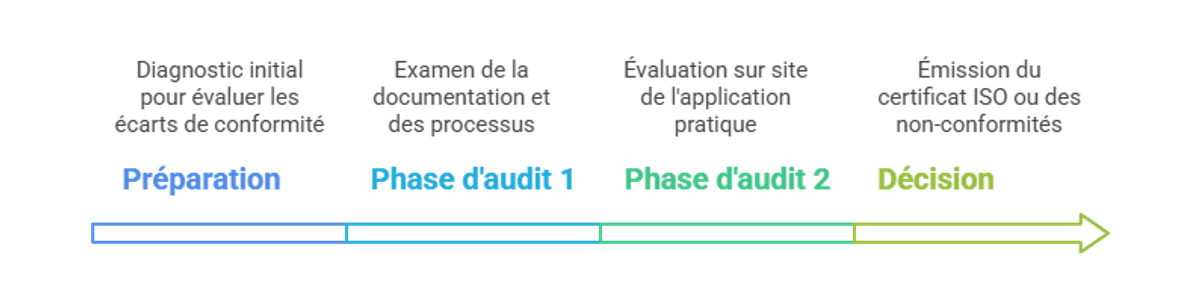
The ISO certification process takes place in several stages:
Preparation: This stage includes an initial diagnosis to assess the gaps between the company's current practices and the requirements of the ISO standard. This helps define an action plan to close these gaps.
Certification audit:
Stage 1: The certification body reviews the company's documentation and processes to ensure they meet the criteria of the ISO standard. This stage focuses on documentary compliance.
Stage 2: A thorough on-site evaluation is carried out to verify the practical application of the documented processes. The auditor observes operations in the field.
Decision: After the audit, the certification body analyzes the results to determine whether the company meets the requirements of the ISO standard. If the criteria are met, an ISO certificate is issued. In the event of non-compliance, the company will need to correct the identified gaps before it can obtain certification.
The cost of certification varies. It depends on the size of the company, the complexity of operations, and specific requirements.
Choosing a certification body
Several criteria are important when choosing an ISO certification body. Reputation and experience of the body are paramount. Some bodies specialize by industry sector. It is therefore crucial to choose a certifier with relevant experience in your field. Testimonials and case studies can provide valuable insights. Examples of certification bodies and their sectors:
AFNOR Certification: Energy, environment, and quality sectors.
Bureau Veritas: Maritime, aerospace, construction, and food sectors.
SGS: Agriculture, minerals, petrochemicals, and consumer goods sectors.
TÜV SÜD: Automotive, transportation, healthcare, and manufacturing sectors.
DNV GL: Renewable energy, healthcare, and risk management sectors.
Intertek: Industrial products, health, and consumer safety sectors.
Lloyd's Register: Maritime, oil and gas, and financial services sectors.
ISO certification is a major asset for businesses, strengthening their credibility and competitiveness. Certification bodies play an essential role in this process, ensuring rigor and transparency. Companies considering certification should choose a recognized and competent body. The CountAct solution is the way to place the health and safety of employees at the heart of a company's concerns. Indeed, integrating a digital solution in a field such as occupational health and safety allows a company to demonstrate its genuine commitment to protecting its employees. It enables you to rigorously track your performance indicators in terms of occupational health and safety.
Need help choosing the right certification body?
Selecting the right ISO certification body and preparing for the audit can be complex. Our team can guide you through the process, from gap assessment to final certification.
SécuQuiz
Test your knowledge
Question 1 sur 5
What is the primary role of a certification body?
Sources & references
Frequently asked questions
Tom BasinStrategic Partnerships Manager
Holding a Master's degree in risk prevention, Tom Basin serves as Partnerships Manager at CountAct, contributing to the development and rollout of the first turnkey crisis management support solution, with the aim of putting security back at the heart of businesses. His experience, along with his training at the Master's level and at the Institut national des hautes études de la sécurité et de la justice, gives him a broad perspective on security and crisis management.