
ICPE: Declaration, Registration or Authorisation, Differences and Obligations
An ICPE (classified installation) falls under one of three regimes: declaration, registration or authorisation. The regime depends on the ICPE nomenclature headings and the thresholds your activity exceeds. The higher the risk, the heavier the procedure: online filing, a simplified file, or a full file with a hazard study and public inquiry.
How is the regime of an ICPE determined?
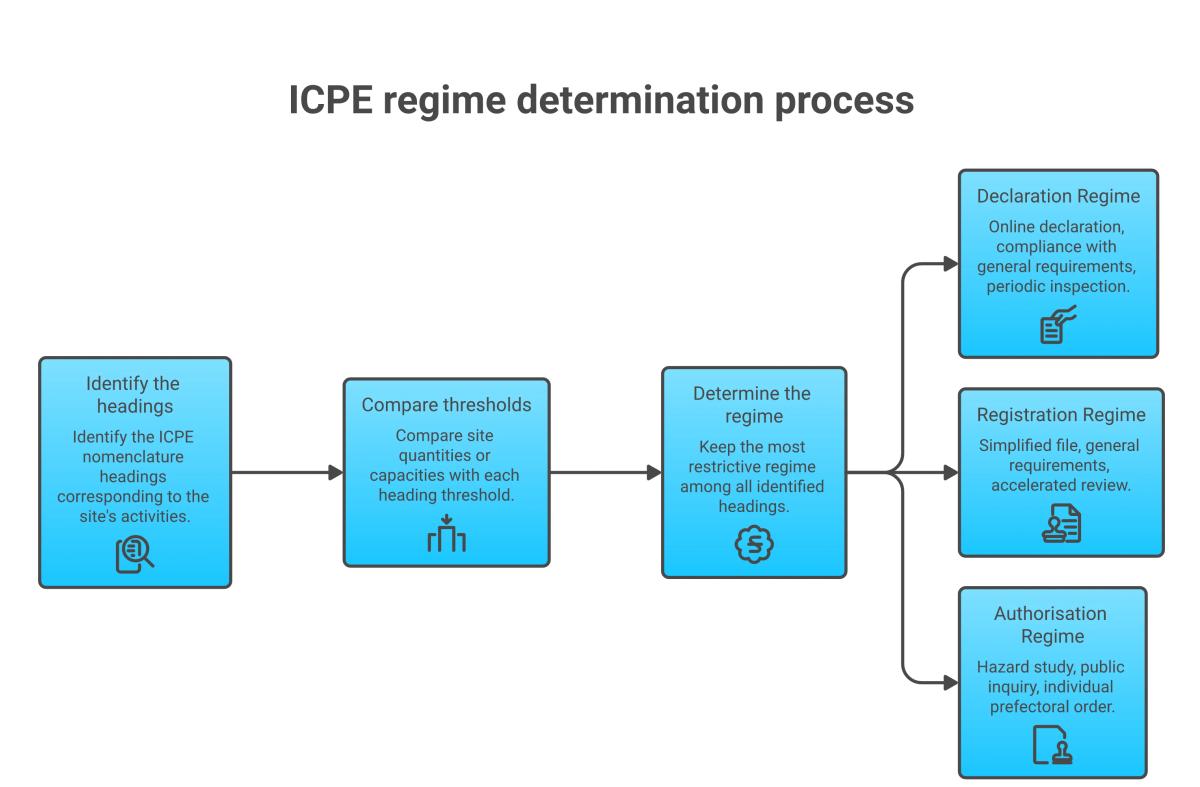
The French Environmental Code defines classified installations in article L.511-1: plants, workshops, warehouses, farms or quarries likely to create risks or nuisances. Each activity is identified by a nomenclature heading with thresholds (quantity stored, power, capacity, surface). Exceeding a threshold moves the installation into a regime.
A site often has several headings. According to service-public.fr, when several headings apply, the most restrictive regime prevails. Never stop at the main heading: a small ancillary storage can change everything.
Declaration: the lightest regime
The declaration regime (article L.512-8) covers installations that do not present serious hazards or nuisances. The operator files online with the prefecture before commissioning and complies with the general requirements set by ministerial order. The prefect cannot oppose operation if the file is compliant.
Declaration with periodic inspection
Some headings are subject to periodic inspection by an approved body. According to service-public.fr, the inspection takes place at least every five years. It is at your expense and its result may require corrective actions.
Registration: the intermediate regime
Registration (article L.512-7) targets activities whose risks are known and can be controlled by general requirements. The file is simpler than for authorisation, the public is consulted and review is faster: around five months from the date the file is complete. A hazard study is not required as it is for authorisation.
Authorisation: the most demanding regime
Authorisation (article L.512-1) applies to installations presenting serious hazards or nuisances. The file includes a hazard study, a public inquiry is held and the prefect sets individual requirements by order. Expect a review significantly longer than for registration.
A SEVESO site is an ICPE subject to authorisation, but not every ICPE subject to authorisation is a SEVESO site. ERP (establishments open to the public) fall under a separate fire safety regulation.
For the difference between lower and upper tier, read our article Seveso lower-tier vs upper-tier. For an overview, see the essential ICPE SEVESO guide.
Registration or authorisation: what changes
The two most commonly confused regimes, compared on the points that matter to the operator.
| Registration | Authorisation | |
|---|---|---|
| Risk level | Known risks, controllable by general requirements | Serious hazards or nuisances |
| File | Simplified | Full, with hazard study |
| Public involvement | Public consultation | Public inquiry |
| Review time | Around 5 months after complete file | Significantly longer |
| Requirements | General ministerial order | Individual prefectoral order |
What obligations apply once the regime is set?
The regime is not limited to the initial filing. The operator must comply with the applicable requirements, keep documents up to date, report any significant change to the prefecture and accept visits from the classified installations inspectorate, carried out by the DREAL. Depending on the site, an internal organization plan may also be required.
This is where spreadsheet tracking becomes a risk: on sites tracked that way, one obligation in four is missed or poorly documented. You deserve better than Excel and WhatsApp.

Manage your ICPE obligations with CompliAssist
CompliAssist tracks your regulatory obligations, computes your ScoreRisk and generates your reports automatically. This application belongs to the Property Security shield.
It presents general rules. To classify your installation and identify the applicable procedures, contact the DREAL, the prefecture or a specialised consultancy.
SécuQuiz
Test your knowledge of ICPE regimes
Question 1 sur 3
Which ICPE regime requires a hazard study?
Sources & references
- Classified installations: regimes and procedures (service-public.fr) — service-public.fr
- French Environmental Code, Book V, classified installations — Légifrance
Frequently asked questions
Tom BasinStrategic Partnerships Manager
Holding a Master's degree in risk prevention, Tom Basin serves as Partnerships Manager at CountAct, contributing to the development and rollout of the first turnkey crisis management support solution, with the aim of putting security back at the heart of businesses. His experience, along with his training at the Master's level and at the Institut national des hautes études de la sécurité et de la justice, gives him a broad perspective on security and crisis management.