
Remote work: regulatory reference points in occupational health and safety
Télétravail → I'll translate the HTML content directly now, preserving tags and attributes. The global spread of COVID-19 has driven major changes in the way companies operate on a daily basis. The widespread adoption of remote work stands out as one of the most notable developments in the professional world. Many companies were faced with the need to maintain their operations while safeguarding the health of their employees. As a result, they quickly pivoted to remote working models. We can therefore speak of a new "remote work generation". The widespread adoption of remote work has raised complex issues, particularly those related to corporate security. Implementing security protocols suited to these new working arrangements has proven essential to ensure the protection of employees.
What is remote work?
Definition:
According to the French Labour Code (Articles L1222-9 to L1222-11), remote work is a form of work organization in which work that could have been carried out on the employer's premises is performed by an employee outside those premises. The employee must be a volunteer. They use information and communication technologies.
Key figures:
We have observed a massive rise in remote work since the health crisis. As a result, it is following this period that we can speak of a new remote work generation. Indeed, before 2019, remote work was rare and exceptional, practiced by only 4% of employees. However, in 2021, remote work became a standardized and widespread way of organizing work, practiced by 27% of employees. According to INSEE, in 2023, approximately 47% of French companies had incorporated some form of remote work into their operations. As this chart shows, according to INSEE, the majority of remote workers are managers/executives: in 2021, on average each week, 55% of managers worked remotely.
What are the arrangements for implementing remote work?
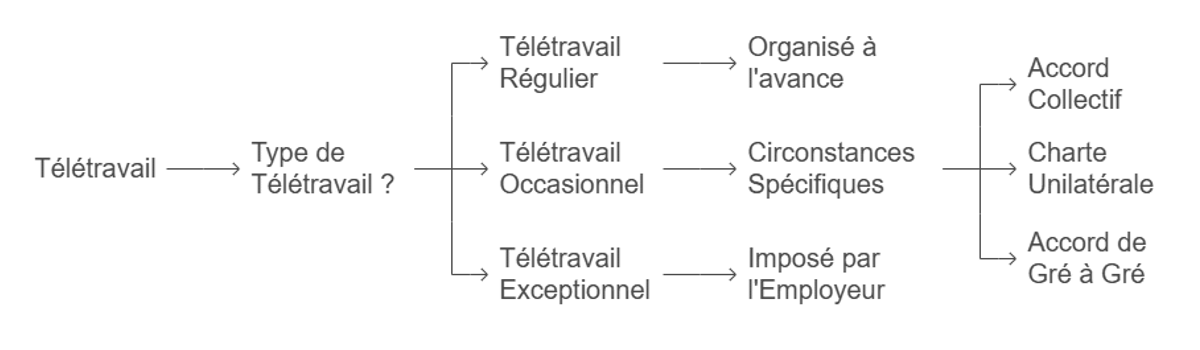
Today, there are three forms of remote work: 1° Regular remote work This is arranged in advance, with a fixed number of days over a given reference period: for example, 5 days per month, one day per week, etc. 2° Occasional remote work This is provided for in certain specific individual circumstances such as pregnancy or disability; particular personal family situations, or "personal convenience" situations to work in a quiet environment, transport strikes, etc. These two forms of remote work are defined and governed:
- either by a collective agreement;
- or, in the absence of a collective agreement, by a charter drawn up unilaterally by the employer;
- or, in the absence of a collective agreement or charter, by a mutual agreement between the employee and their employer.
3° Exceptional remote work This can be imposed by the employer:
- In the event of exceptional circumstances, particularly the threat of an epidemic,
- In the event of force majeure, particularly: a disaster on company premises, natural disasters affecting means of transport, etc.
According to the Labour Code, in these cases, the implementation of remote work can be considered an adjustment to the workstation made necessary to ensure the continuity of the company's operations and guarantee the protection of employees.
An accident occurring at the place where remote work is performed, during the course of professional activity, is presumed to be a workplace accident, just as it would be if it happened on company premises.
The remote work charter:
Implementing a remote work charter within a company aims to define the rules governing remote work. It serves as a practical guide when an employer wishes to introduce this arrangement within the organization. In this new era of the remote work generation, it is essential to establish a framework to ensure it runs smoothly. It is important to note that the remote work charter is not mandatory, since remote work can also be introduced through a collective agreement or, on an occasional basis, through a simple agreement between the employee and the employer, as seen previously. However, it is strongly recommended to draw up a remote work charter when an employer plans to implement this practice. This charter helps to secure the use of remote work. It should also be noted that the introduction of the remote work charter is subject to the opinion of the Social and Economic Committee (CSE), if one exists within the company. At CountAct, we have remote work charter templates that we can make available to you. Contact us directly either via an appointment or by email: countact@countact.fr
Need help drafting your remote work charter?
Setting the right rules for remote work protects both your company and your employees. Our team can help you draft a charter tailored to your organization.
What are the health and safety obligations?
Even though remote work can be beneficial, it generates new risks that must be recognized. Indeed, for the employer to comply with their health and safety obligation towards employees, they must take these risks into account. Furthermore, they must record them in their Single Occupational Risk Assessment Document (DUERP). As a reminder, the DUERP must be updated at least once a year or on a regular basis. For example, whenever a significant change in arrangements alters hygiene, safety, or working conditions. Thus, in the context of the massive growth of remote work, new types of risks have emerged. It is therefore inevitable to update the DUERP accordingly.
Employer's obligation:
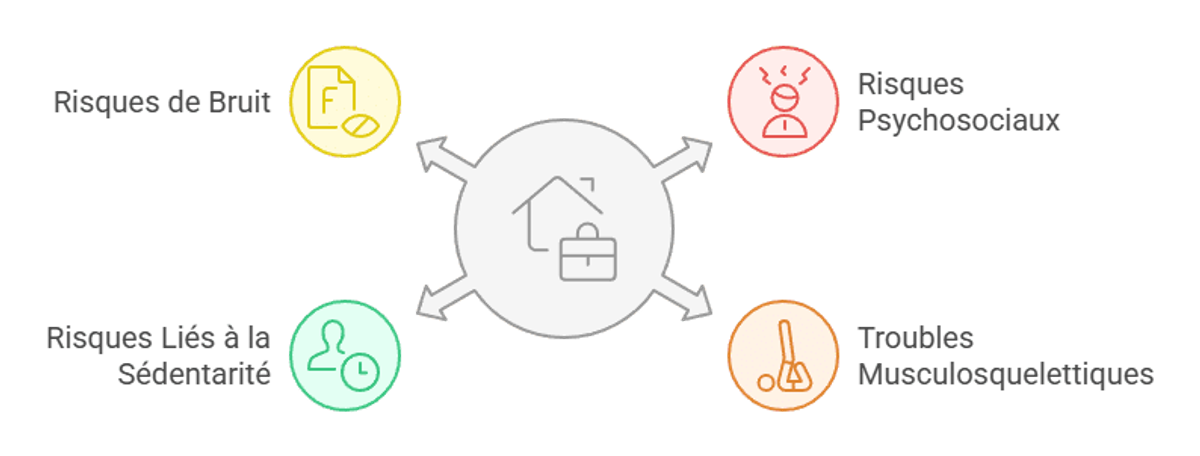
The employer remains bound by the general obligation set out in Article L.4121-1 of the Labour Code, namely to "take the measures necessary to ensure the safety and protect the physical and mental health of workers". Thus, the employer must identify the risks associated with remote work, assess them, update the DUERP, and define prevention measures appropriate to this new way of organizing work. Here are examples of 4 types of risks that are not exclusive to remote work but are heightened by this way of organizing work:
1) Psychosocial risks (PSR)
The use of remote work has led to the emergence of psychosocial risks due to the new organization of work within the company. Indeed, employees are alone at home to carry out their work and lose the social connection with their colleagues. Employees may therefore feel isolated, lose the sense of purpose in their work, and have difficulty separating their professional and personal lives.
2) Musculoskeletal disorders (MSDs)
When working remotely, employees may tend to use unsuitable chairs or workspaces, and therefore experience physical discomfort. To avoid this, it is important to have a dedicated remote work desk at home. In other words, a desk set up specifically for remote work days, arranged accordingly, to provide an optimized and comfortable space. We advise against working on your sofa or a coffee table. Having a dedicated remote work desk provides a physical and psychological space that is essential for your physical and mental health. Finally, this dedicated remote work desk set up at home will make it easier to manage the balance between work and personal life. Indeed, a space specifically dedicated to your working time creates a physical boundary between your daily life at home and the time set aside for remote work.
3) Risks related to sedentary behavior
Among other things, sedentary behavior can be responsible for health problems, cardiovascular diseases, etc.
4) Noise-related risks
Ambient noise can affect employees' mental health. This type of risk is therefore closely linked to psychosocial risks. Indeed, the home is not always suited to working in an environment conducive to concentration.
Employee's obligation:
Obligation to take care of one's health and safety (Art. L. 4122-1 of the Labour Code) The remote worker, like any employee of the company, remains under the authority of their employer and is required to take care of their own health and safety. This is reflected in the obligation to take into account the instructions given regarding the arrangement of their workstation and compliance with working hours and rest periods.
What are the key points of vigilance regarding health and safety?
Finally, remote work presents several security challenges for employees within companies. Here are some of the main concerns:
1) Communicating security instructions:
Effectively communicating security instructions becomes a challenge when employees work remotely. It is therefore essential to establish clear and accessible communication channels so that information reaches every member of the team. On this point, we can advise you in finding the right process or communication tool.
2) Tracking on-site presence:
Managing employee presence on site becomes more complex with remote work. However, for safety reasons, it is important to know who is present at the company's physical premises. Tracking and workforce management systems are necessary to ensure everyone's safety. With the CountAct application, you can now know which staff members are present on site in order to respond to a safety emergency.
3) Ensuring safety officers are always present on site:
Remote work requires training a larger number of employees as safety officers (Evacuation Guide, Sweep Marshal, First Aid Responder, etc.). Indeed, in a crisis management situation, it is essential to ensure that competent people are present who are capable of handling these situations. Under no circumstances should a company find itself in a situation where all safety officers are working remotely. This would mean that no one would be qualified and trained to manage a crisis situation should one arise. The CountAct application therefore helps you address this issue, since you will now know which safety officers are present on site.
4) Security of employees' homes:
Employees working from home may be exposed to specific risks related to the security of their personal environment. It is therefore important to be aware of the insurance coverage applicable to remote work. According to the Labour Code (Articles L1222-9 to L1222-11), "An accident occurring at the place where remote work is carried out during the performance of the remote worker's professional activity is presumed to be a workplace accident within the meaning of Article L. 411-1 of the Social Security Code." This therefore provides a form of "remote work insurance" for the employee. It is important to raise employee awareness of good home security practices, in order to implement policies that minimize risks, particularly with regard to confidentiality and data protection. To support you in implementing a crisis management system suited to these new challenges, contact us! We will help you deploy the tools and processes needed to ensure your company is compliant with today's new challenges. In summary, the widespread adoption of remote work, driven by the pandemic, has completely redefined our habits and the way we organize work. While this shift has many positive aspects, it also raises certain challenges. Indeed, corporate security management has been completely redefined and must now address new challenges. In conclusion, it is therefore essential for companies to take these developments into account in order to continue ensuring workplace safety for their employees.
SécuQuiz
Test your knowledge on remote work
Question 1 sur 5
According to the French Labour Code, what is a key requirement for an employee to work remotely?
Sources & references
- French Labour Code (Articles L1222-9 to L1222-11) — www.legifrance.gouv.fr
- INSEE — www.insee.fr
- an appointment — calendar.google.com
- Article L.4121-1 of the Labour Code — www.legifrance.gouv.fr
- Art. L. 4122-1 of the Labour Code — www.legifrance.gouv.fr
- (Articles L1222-9 to L1222-11) — www.legifrance.gouv.fr
- Article L. 411-1 of the Social Security Code — www.legifrance.gouv.fr
Frequently asked questions
Tom BasinStrategic Partnerships Manager
Holding a Master's degree in risk prevention, Tom Basin serves as Partnerships Manager at CountAct, contributing to the development and rollout of the first turnkey crisis management support solution, with the aim of putting security back at the heart of businesses. His experience, along with his training at the Master's level and at the Institut national des hautes études de la sécurité et de la justice, gives him a broad perspective on security and crisis management.