
Choosing a crisis management application
In an ever-changing economic and social context, companies are facing new challenges in terms of security. In addition, the rise of remote work, home office and flex office is leading to a reduction in on-site staff. As a result, we can see that a new era of crisis management is taking shape. Having a crisis management application has become more essential than ever. How can companies effectively manage emergency situations in this constantly changing context?
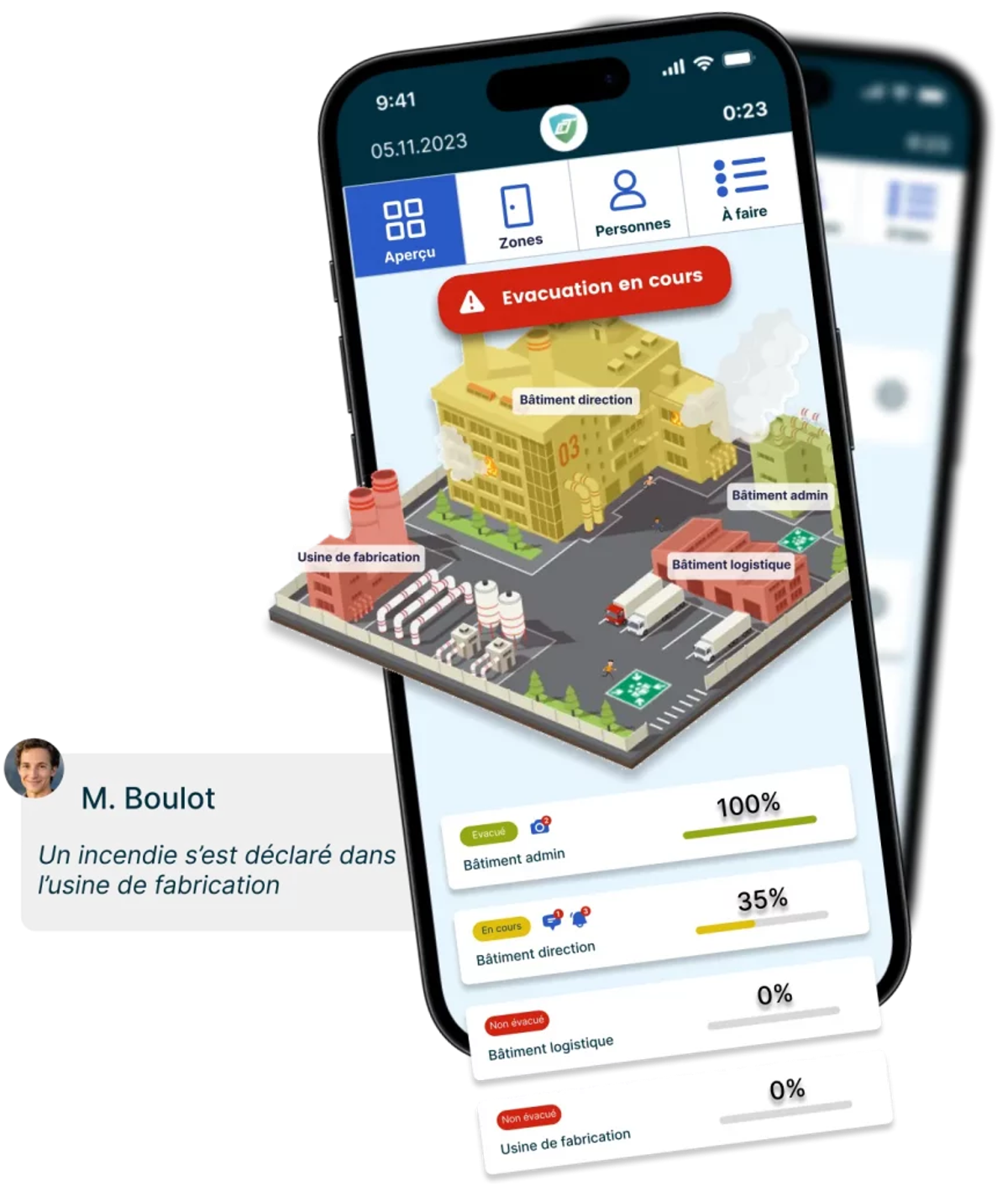
The CountAct crisis management application in action
A disorganization of security
Traditional crisis management methods (walkie-talkies and paper forms) are no longer sufficient. Indeed, companies are facing several factors:
- New ways of organizing work
- The growing complexity of risks
- Information management and traceability
- The need for instant access to information
No longer having enough on-site security personnel (first aiders, fire wardens...), it has become necessary to opt for security applications (crisis management application, fire prevention application, fire warden guide application, etc.) such as CountAct. CountAct provides the number of people present on site, your quick-reference sheets and instructions at your fingertips, while also giving you real-time evacuation indicators... In addition, digital technology enables instant and remote access to relevant security data. A security application or a crisis management application such as the CountAct application has become an essential tool for businesses.
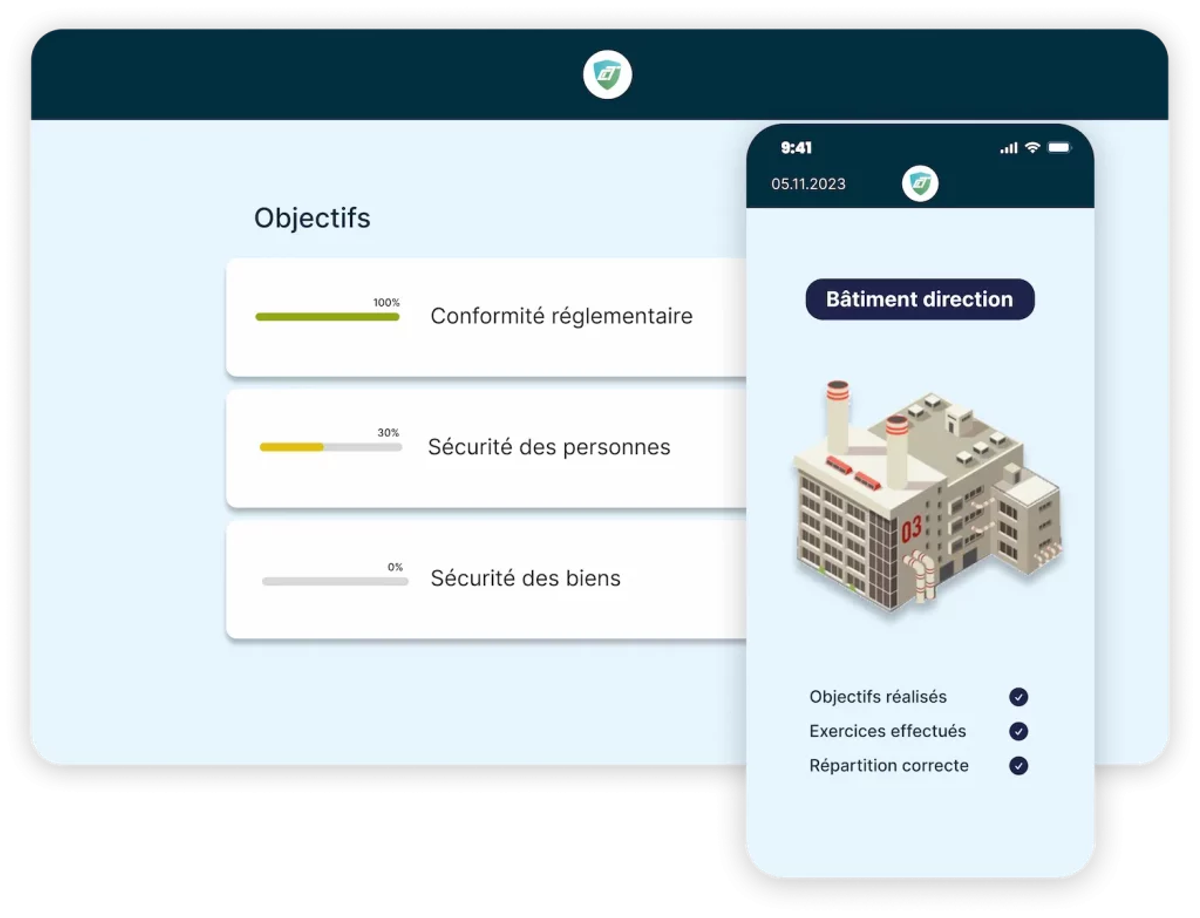
CountAct: the regulatory security compliance management application
Concretely, this means a suite of dedicated applications rather than one generic tool: EvacApp pilots evacuation in real time, floor by floor, LiveCount gives you the exact headcount on site at any moment, AlertApp centralizes and tracks health-safety alerts instead of WhatsApp threads or emails, SafeHuman turns that field data into dashboards and reports, and PPMS lets you trigger and steer emergency protocols (natural disaster, intrusion, attack) in one click. Regulatory compliance tracking and audit-ready reporting fall under CompliAssist, CountAct's asset-safety shield.
Traditional methods vs. CountAct
Before comparing solutions, here's how traditional crisis management stacks up against a dedicated digital application.
| CountAct | Traditional methods (walkie-talkies, paper forms) | |
|---|---|---|
| Access to information | Instant, from any device | Delayed, dependent on paper or radio relay |
| Communication during a crisis | Real-time, targeted to the right people | Limited range, one-to-one or broadcast only |
| Traceability of actions | Automated and fully documented | Manual, incomplete, error-prone |
| Coordination of teams | Structured, day-to-day coordination of the whole community | Fragmented, dependent on available on-site staff |
Digital is the answer: boost your efficiency with CountAct, your crisis management application
A corporate security application (crisis management application, emergency evacuation application, fire warden guide application, etc.) is a key ally in addressing these new security challenges. Indeed, it offers:
- Instant access to information
- A level of information tailored to each employee
- Effective real-time communication
- Agile responsiveness to unforeseen events
- Perfect data traceability
- A structured safety and security process
- Day-to-day coordination of an entire community (first aiders, fire wardens...)
Indeed, it is essential to have automated information management and traceability of your security activities. You can store and organize data securely, generate detailed incident reports, and track your regulatory compliance. The CountAct application will also allow you to establish and monitor your security performance indicators. This simplifies administrative management and reduces the risk of non-compliance. Moreover, it is designed to be agile and flexible. This allows you to quickly adapt to evolving incidents and organize your crisis unit. In conclusion, emergency management in companies is taking on a new dimension in the face of safety and security disorganization. Fortunately, crisis management applications such as CountAct offer an agile, flexible and effective response.
Ready to modernize your crisis management?
See how CountAct gives your teams instant access to information, real-time communication, and complete traceability during a crisis.
SécuQuiz
Test your knowledge
Question 1 sur 5
Traditional crisis management methods like walkie-talkies and paper forms are still sufficient for today's companies.
Sources & references
- application d’évacuation d’urgence — www.legifrance.gouv.fr
Frequently asked questions
Tom BasinStrategic Partnerships Manager
Holding a Master's degree in risk prevention, Tom Basin serves as Partnerships Manager at CountAct, contributing to the development and rollout of the first turnkey crisis management support solution, with the aim of putting security back at the heart of businesses. His experience, along with his training at the Master's level and at the Institut national des hautes études de la sécurité et de la justice, gives him a broad perspective on security and crisis management.