
The Crisis Unit
Discovering One of the Key Internal Actors During an Emergency Evacuation: The Crisis Unit.
This unit holds responsibility for crisis management and the actions to be carried out. Indeed, it must steer operations and make strategic decisions to limit damage as much as possible during a crisis situation. In this article, we will address several points:
- How does a crisis unit work?
- Who is part of the crisis unit?
- What are the 4 elements of a crisis?
- How do you run a crisis unit?
- Why set up a crisis unit?
- What regulations apply to company directors?
How does a crisis unit work?
First of all, the crisis unit is an organization of people serving a decision-maker. This organization, which aggregates a range of information, is at the heart of the crisis process. In this article, we will focus mainly on the emergency evacuation process and its management once an evacuation situation is triggered.
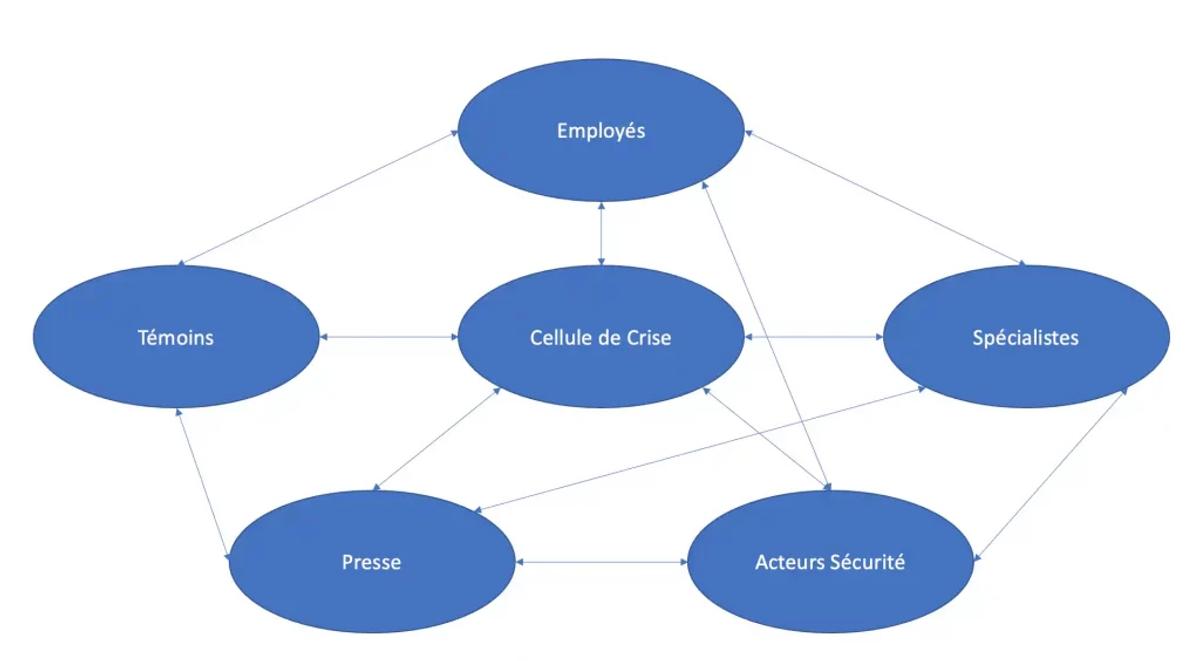
Thus, the way a crisis unit operates is simple. This organization takes in incoming information, masters it, and gives it meaning. It is then responsible for disseminating outgoing information and the strategic decisions made during the crisis. The crisis unit therefore creates consistency to enable decision-making. It is made up of decision-makers who have the experience and skills to support the management of emergency situations. So, let's find out who they are…
Who is part of the crisis unit?
As explained above, the crisis unit is made up of decision-makers and strategists. In some cases, you may also find external contributors, such as consultants specializing in crisis situations or communication. Furthermore, let's not forget that communication is part of crisis management. Indeed, it is very important to have people responsible for communication within the crisis unit so that information can be disseminated in a consistent manner (managing internal communication, the press, neighboring residents, etc.). Legal officers are also invited to provide advice on the regulatory framework surrounding the decision-makers.
What are the 4 elements of a crisis?
The 4 elements of a crisis must be managed before it even begins. Indeed, it starts with prevention and all the groundwork carried out beforehand. The site manager must reduce the risks present within the company as much as possible. To do this, they roll out a prevention philosophy and campaign internally, implementing actions aimed at reducing risks. Note that subsidies and assistance are available for implementing these actions. The second element concerns preparation for the crisis. It is extremely important to practice and rehearse in order to prepare for a crisis. Indeed, the very nature of a crisis is to deal with the unexpected. Without preparation, crisis management will almost certainly fail, and the worst outcome (loss of life) becomes a real possibility. Next comes response time. This relates to the crisis itself and spans from the moment the alert is raised until it is lifted. Finally, there is the Post-Incident Review, also known as Adaptation. Indeed, this is one of the most important steps, as it forms part of a continuous improvement process. To support companies in their crisis management, CountAct has created the first solution to help you with all 4 of these elements.
How do you run a crisis unit?
Running a crisis unit is straightforward. To do so, you need a clear definition of the positions and roles that make it up. This model is fully adaptable, but for example:
- First, there is a Crisis Unit Manager. Very often, it is the Site Manager (who bears the greatest liability in the event of harm) who acts as the head of the Crisis Unit.
- Next, there are several people who coordinate. These coordinators supervise, organize, and advise the manager on strategic decision-making. They also keep the crisis unit's communications team informed.
- The emergency line, also called the secretariat, which handles the archiving of documents and information at the Crisis Command Post. It acts as support for ancillary tasks that cannot be carried out by the decision-makers.
One important point: to run the Crisis Unit effectively, it must be well equipped! Indeed, a Crisis Unit needs to receive a minimum amount of information in order to make decisions based on tangible facts. Otherwise, it risks making mistakes in its strategic decisions. Today, the most advanced crisis units are equipped with video surveillance covering all sensitive points. But that is not enough, which is why CountAct can equip your Crisis Unit to obtain real-time evacuation and crisis management indicators.
A crisis unit is only as effective as its equipment. Make sure the room has reliable communication tools, updated contact lists, site plans, and backup power before an emergency ever occurs.
Why set up a crisis unit?
As mentioned in the article on Occupational Health and Prevention Services, health and safety represent a genuine human stake. Setting up a crisis unit is essential, as it provides support to decision-makers during crisis management. It allows them to implement fast, effective actions and to control the information they receive and pass on. Indeed, decisions must be made continuously and adjusted as a crisis unfolds. Having a panel of experts and support resources is essential and indispensable for effective crisis management. Finally, it is essential to set one up to ensure compliance with health and safety laws, especially if your site carries out hazardous activities. Let us remember that a site director can be held criminally liable for Inexcusable Organizational Fault should harm occur. The role of the Crisis Unit is therefore essential given the liability borne by decision-makers. Let's take a look at the regulations concerning the liability of company directors.
What regulations apply to company directors?
Today, in France, it should be noted that an employer's criminal liability may be engaged in the event of non-compliance with workplace health and safety rules. Consequently, every employer must constantly ensure that all their prevention and safety measures are kept up to date. The CountAct solution enables employers to put measures in place to protect themselves against legal action. Employers and the crisis unit are also advised by occupational health services (SPSTI), who are responsible for supporting and advising them on the solutions available. You now know what a Crisis Unit is and its scope of action during a crisis. We therefore invite you to read our article on safety actors to further your knowledge of the key safety roles within a company.
Need Help Setting Up Your Crisis Unit?
Get expert support to structure, train, and equip your crisis unit so your organization is ready to respond effectively to any emergency.
SécuQuiz
Test your knowledge
Question 1 sur 5
What is the primary role of the crisis unit during an emergency evacuation?
Sources & references
- the crisis unit is made up of decision-makers and strategists — www.gouvernement.fr
- criminal liability — www.legifrance.gouv.fr
Frequently asked questions
Tom BasinStrategic Partnerships Manager
Holding a Master's degree in risk prevention, Tom Basin serves as Partnerships Manager at CountAct, contributing to the development and rollout of the first turnkey crisis management support solution, with the aim of putting security back at the heart of businesses. His experience, along with his training at the Master's level and at the Institut national des hautes études de la sécurité et de la justice, gives him a broad perspective on security and crisis management.