
PPMS
In recent years, managing school emergencies has become a growing concern. At the heart of this preparation lies the Specific Safety Plan (PPMS). This plan is a strategic tool designed to anticipate and effectively manage incidents that may occur within the school environment. The PPMS offers a structured response for nearly every emergency scenario, from natural disasters to malicious intrusions. This article dives into the heart of the PPMS, explaining its definition, its importance, and detailing how it fits into the security routine of schools and other institutions.
What is the PPMS?
The unified PPMS, once split into two distinct parts (PPMS for major risks and PPMS for attack-intrusion), is a protocol established within French educational institutions. It addresses several key issues:
Preparing for and responding to critical emergencies that could threaten people's safety.
It raises awareness among and prepares all education staff to act in a coordinated manner during unforeseen events.
It aims to establish clear guidelines for properly managing major risks (evacuation/lockdown) and intrusions (lockdown).
Effective implementation of the PPMS requires several key steps:
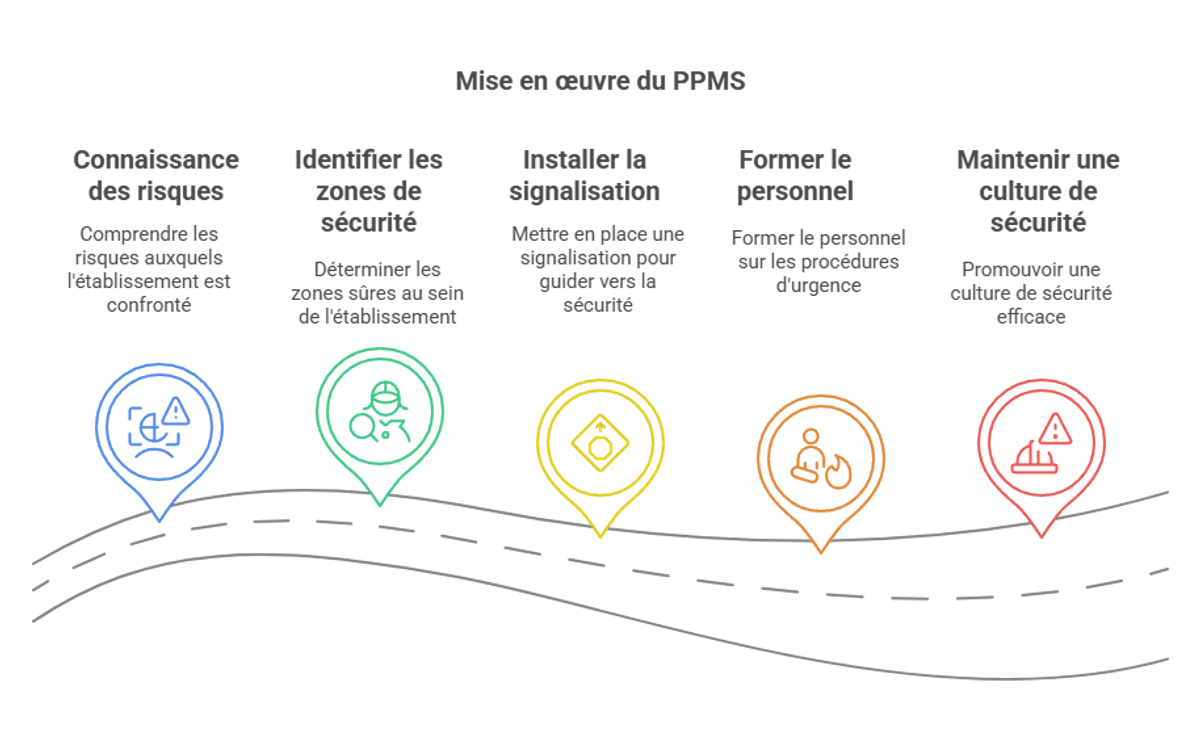
Since 2023, institutions have been required to update their PPMS. The identification sheet required for the PPMS includes essential contacts such as:
All institutions must update their PPMS and complete the identification sheet, including the security liaison officer, judicial liaison officer, and contact details for the prefecture, rectorat, and DSDEN.
The safety/security liaison officer for the Internal Security Forces
The judicial liaison officer
The prefecture's contact details
The regional education authority's (rectorat) contact details
The DSDEN's contact details.
To update it, institutions can rely on their rectorat, which has specialized liaison officers. If needed, CountAct offers PPMS customization tailored to each institution's structure.
Implementing the PPMS in primary schools
Implementing the PPMS in primary schools is a structured and customized process. For each institution, the PPMS must be designed taking into account local specifics, such as geography, the immediate environment, and risks specific to the area. In primary schools, where children are particularly vulnerable, the plan emphasizes simple and understandable procedures for young minds. Simulation drills are also essential. They must be carried out regularly to ensure that students and staff are prepared and know how to react instinctively. With this in mind, CountAct offers an intuitive platform that transforms the PPMS from a static document into a living, dynamic, and interactive tool. The platform makes it possible to create, modify, and distribute PPMS drill scenarios in a simple, centralized way, ensuring that students and staff are always prepared with the latest version of the plan.
Adapting the PPMS in secondary schools
When considering the application of the PPMS beyond elementary schools, it becomes clear that its implementation must be adapted to the needs and context. Middle and high schools often have a larger number of students, more complex buildings, and offer varied educational programs. Indeed, students are more autonomous and able to understand complex instructions, which allows for the integration of more sophisticated safety protocols into the PPMS. CountAct enriches PPMS management with its digital platform, ensuring effective emergency preparedness and response. Our solution, accessible via an app, equips institutions with tools to design and manage their PPMS intuitively. CountAct also supports the drafting process with performance indicators. These ensure continuous updating and optimization of the PPMS based on each institution's specific needs.
Three drills a year: Preparing for intrusions and other risks
Schools must organize three annual drills under the PPMS. Specifically, two for major risks and one for attack-intrusion.
Variety of drills
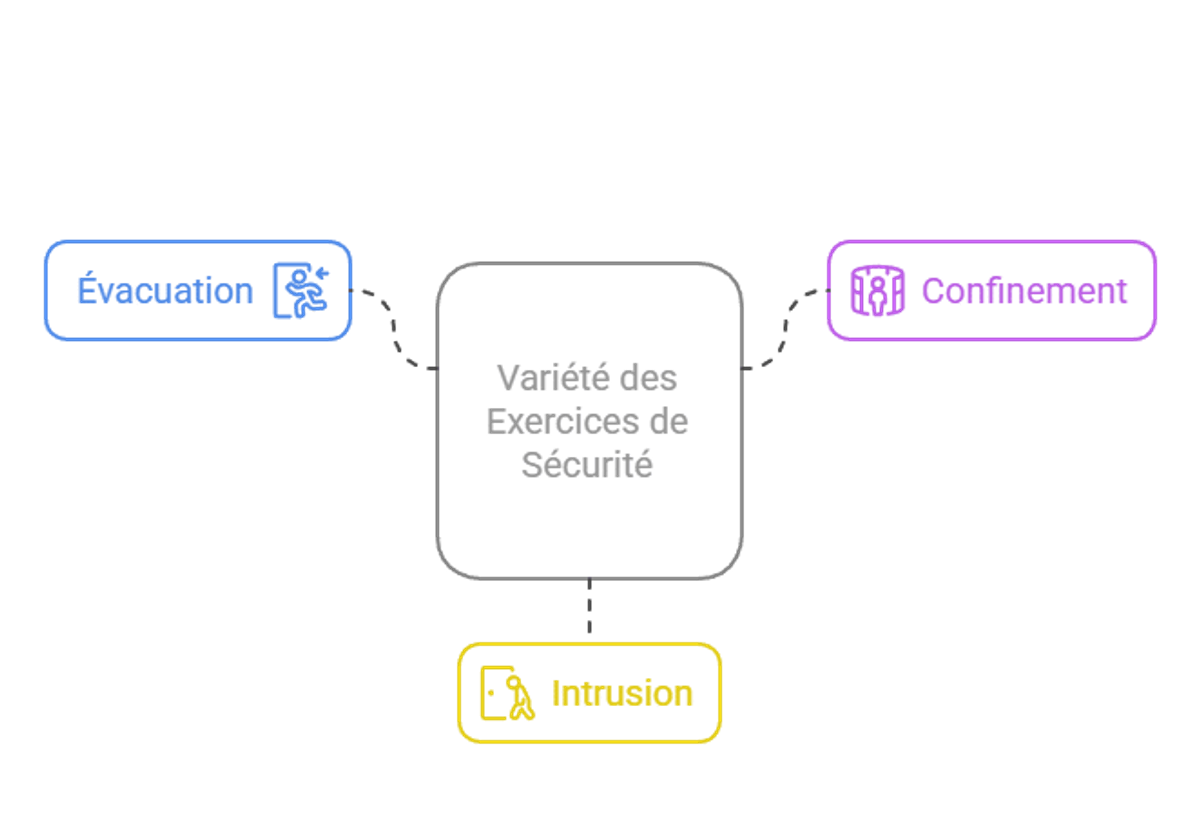
PPMS drills come in several types to cover the range of potential emergency situations:
Evacuation drills: these prepare people to leave the building in an orderly manner and without panic, for example in the event of a fire or a gas leak.
Lockdown drills: these teach people how to protect themselves in place against external dangers such as chemical releases or extreme weather events.
Intrusion drills: these aim to ensure the correct response in the event of unauthorized entry or an act of violence, minimizing exposure to danger.
Each type of drill relies on precise scenarios, clearly defined alert signals, roles, and procedures to follow. This makes it possible to test the institution's readiness for various risk scenarios. To optimize these drills, introducing digital solutions such as CountAct is a real asset. CountAct can help simulate more realistic scenarios through its digital platform. It enables the use of interactive visualizations of threats and appropriate responses. It can also provide post-drill analysis, highlighting effective responses and areas needing improvement. The PPMS is more than an emergency plan; it is a commitment to safety.
Need help implementing your PPMS drills?
Get expert support to plan, organize, and run compliant evacuation, lockdown, and intrusion drills for your school.
SécuQuiz
Test your knowledge: the PPMS explained
Question 1 sur 5
What does the acronym PPMS stand for in the context of French schools?
Sources & references
- doivent actualiser leur PPMS. — www.education.gouv.fr
- CountAct — calendar.google.com
Frequently asked questions
Tom BasinStrategic Partnerships Manager
Holding a Master's degree in risk prevention, Tom Basin serves as Partnerships Manager at CountAct, contributing to the development and rollout of the first turnkey crisis management support solution, with the aim of putting security back at the heart of businesses. His experience, along with his training at the Master's level and at the Institut national des hautes études de la sécurité et de la justice, gives him a broad perspective on security and crisis management.