
Restaurant Fire Safety: The Type N ERP Obligations You Need to Know
Restaurants and type N ERP status: the general framework
A restaurant, a bar, or a similar establishment (brasserie, tea room) is classified as a public-access establishment (ERP) of type N under the chapter III of the fire safety regulation, set by the amended decree of 25 June 1980. This regime applies as soon as premises serve meals or drinks for on-site consumption, regardless of size.
As with any ERP, the concrete intensity of the obligations then depends on the establishment's category, from 5th to 1st, determined by the number of people it can accommodate. This classification notably sets the frequency of visits from the safety commission.
A 5th-category restaurant, often a small independent establishment, and a 1st-category restaurant belonging to a large chain do not follow exactly the same verification schedule, nor the same frequency of safety commission visits. Only an accredited inspection body or the relevant prevention service can confirm your establishment's exact category.
Professional kitchens: the threshold that changes everything
Once the combined useful power of cooking and reheating appliances exceeds 20 kilowatts, the room is classified as a "grande cuisine" (large kitchen) and falls under a stricter regime, set by chapter X of the fire safety regulation (Article GC 1). Below that threshold, or for 5th-category establishments, a dedicated section on cooking installations applies instead (Articles PE 15 to PE 19).
For large kitchens in 5th-category establishments, Article PE 16 sets out construction and ventilation requirements: hoods or capture devices must include grease-retaining elements that are easy to clean and replace, and the energy supply to each cooking appliance must be cut off by a clearly identifiable emergency shutoff device.
Calculating the combined useful power of your cooking appliances (oven, hobs, fryers, etc.) determines which regulatory regime applies to your kitchen. Only a qualified installer or an inspection body can establish this calculation for your establishment.
Maintaining extraction ducts and hoods: a documented obligation
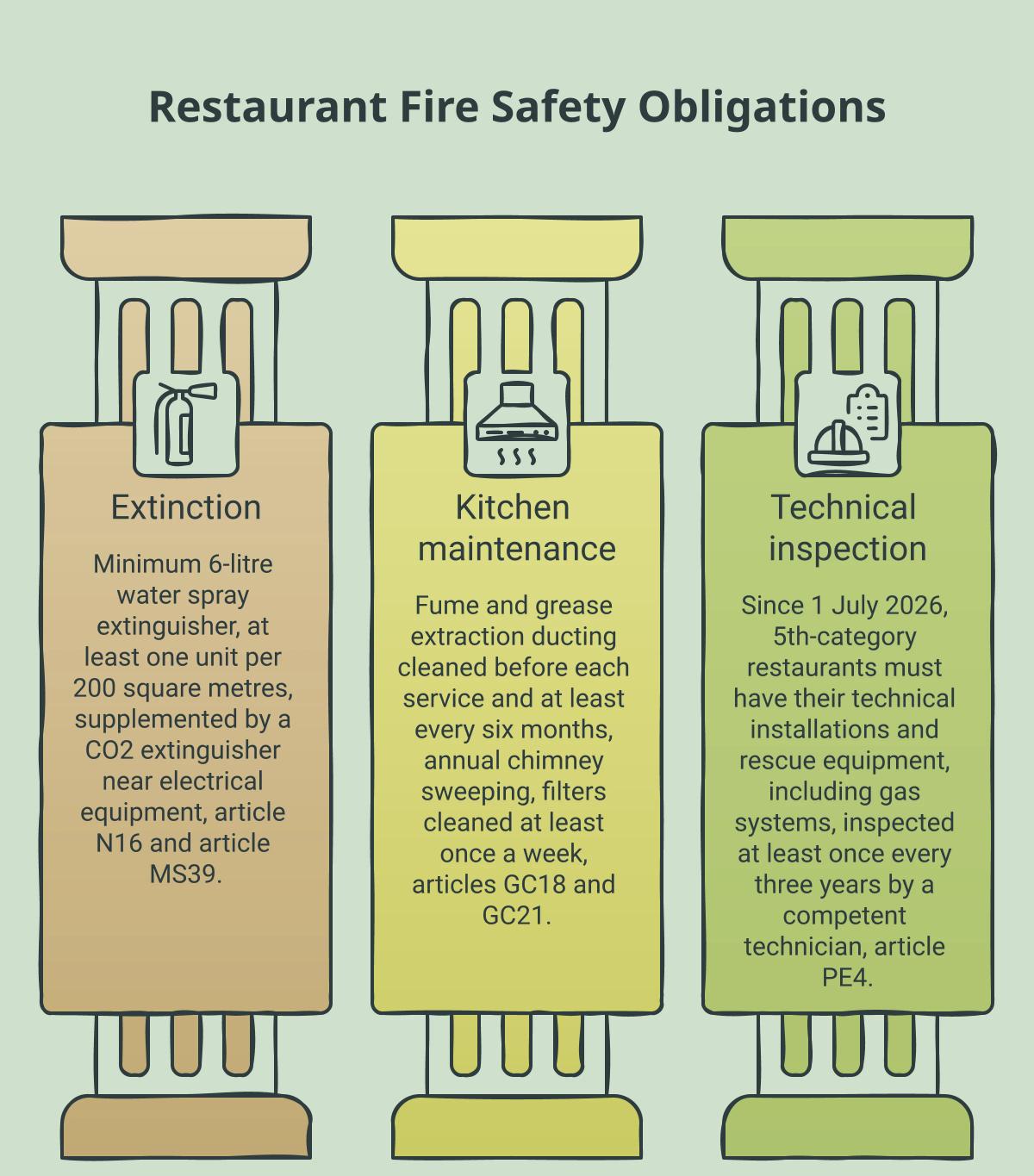
For large kitchens, Article GC 21 requires sweeping and checking the clearance of extraction ducts at least once a year, along with cleaning or replacing filters at least once a week. During periods of activity, cooking appliances and the fume and grease extraction circuit, including fans and heat recovery units, must be cleaned as often as necessary.
For the installations covered by this requirement, Article GC 18 further specifies that the fume and grease extraction duct must be cleaned before each installation and at least every six months, a benchmark widely used as the reference frequency across the industry.
These maintenance operations, along with their dates, must be recorded in the establishment's safety register.
Grease build-up in a poorly maintained extraction duct is one of the most common causes of fire in professional kitchens. Untracked maintenance can also be flagged during a safety commission visit and contribute to an unfavorable opinion.

Centralize your restaurant's compliance tracking
CompliAssist continuously tracks your establishment's ERP (and health, where applicable) obligations and calculates your ScoreRisk: the documented proof to present to the safety commission or your inspection body.
Firefighting equipment suited to kitchen risks
The Article N 16 of the fire safety regulation requires portable water-spray extinguishers of at least 6 litres, sensibly distributed at a minimum of one per 200 m², plus additional equipment suited to the establishment's specific risks.
Article MS 39 of the fire safety regulation specifies that extinguishers must be distributed appropriately to the risks they need to fight, notably electrical ones: in a kitchen, this points concretely to a CO2 extinguisher near electrical equipment, alongside the water-spray extinguisher. The extinguisher type chosen depends directly on the nature of the risk covered, which makes a prior risk analysis essential, particularly for deep-fat fryer fires.
Our dedicated article details the uses and limits of the CO2 extinguisher for this type of risk.
Keeping a fire blanket near cooking stations is a recommended prevention practice to smother a starting fryer fire or protect someone whose clothing has caught fire, but it does not replace a suitable extinguisher or the risk analysis carried out by your inspection body or prevention service.
Restaurant fire safety compliance: two ways to prepare
| Documented tracking (up-to-date register, ScoreRisk) | Paper or standalone spreadsheet tracking | |
|---|---|---|
| Safety commission visit | File available immediately, dated history | Document search under pressure, risk of unfavorable opinion |
| Extraction duct maintenance (Art. GC 18, GC 21) | Cleaning dates tracked and accessible | Tracking forgotten, higher fire risk |
| Triennial installation verification (Art. PE 4, from 2026) | Deadlines tracked per establishment | Deadline easily missed, especially across multiple sites |
| Proof of gas and firefighting resource checks | Centralized reports, accessible to the competent technician | Documents scattered across different contractors |
2026 update: triennial verification now covers 5th-category restaurants
The decree of 1 December 2025 amending the decree of 25 June 1980 extends to 5th-category establishments, a status that covers a large share of independent restaurants, the obligation to have the establishment's technical installations and equipment, heating, lighting, electrical installations, gas installations, elevators and firefighting resources, verified every three years at most by competent technicians. These provisions, set out in Article PE 4, came into force on 1 July 2026, alongside a systematic check of new or modified gas installations before the establishment reopens, a notable point for a kitchen whose gas installation has been redone.
Among the businesses CountAct works with, one regulatory obligation in four is missed or poorly documented when tracked only through a spreadsheet. Technical verification and kitchen maintenance deadlines are no exception, particularly for multi-site establishments.
What to keep in mind before digitizing your tracking
Type N ERP classification, the large-kitchen threshold, extraction duct maintenance, extinguishers suited to electrical and fryer-fire risks: these obligations form a coherent baseline, reinforced for 5th-category restaurants by the triennial verification that came into force in 2026. A tool like ScoreRisk, part of CompliAssist, formalizes this tracking continuously, without replacing the safety commission, an accredited inspection body, or a competent technician.
Nothing in this article constitutes personalized legal advice. Only the safety commission, an accredited inspection body, or a legal professional can precisely assess your establishment's situation.
SécuQuiz
Test your knowledge of restaurant fire safety
Question 1 sur 4
A restaurant falls under the same regulatory regime regardless of how many people it can accommodate.
Sources & references
- Chapter III: Type N establishments, restaurants and drinking establishments (Articles N 1 to N 20) — Légifrance
- Article GC 1 - Decree of 25 June 1980 (large kitchen definition, 20 kW threshold) — Légifrance
- Article PE 16 - Decree of 25 June 1980 (large kitchens in 5th-category establishments, ventilation, grease retention) — Légifrance
- Article GC 18 - Decree of 25 June 1980 (duct cleaning before installation and every six months) — Légifrance
- Article GC 21 - Decree of 25 June 1980 (duct maintenance, annual sweeping, weekly filters) — Légifrance
- Article MS 39 - Decree of 25 June 1980 (extinguisher placement according to risks, including electrical) — Légifrance
- Article PE 4 - Decree of 25 June 1980 (5th category, triennial verification) — Légifrance
- Decree of 1 December 2025 amending the decree of 25 June 1980 — Légifrance / Journal officiel
Frequently asked questions
Tom BasinStrategic Partnerships Manager
Holding a Master's degree in risk prevention, Tom Basin serves as Partnerships Manager at CountAct, contributing to the development and rollout of the first turnkey crisis management support solution, with the aim of putting security back at the heart of businesses. His experience, along with his training at the Master's level and at the Institut national des hautes études de la sécurité et de la justice, gives him a broad perspective on security and crisis management.