
Hotel Fire Safety: The Type O ERP Obligations You Need to Know
Hotels and type O ERP status: the general framework
A traveler's hotel, a furnished hotel, or a boarding house is classified as a public-access establishment (ERP) of type O under the chapter IV of the fire safety regulation, set by the amended decree of 25 June 1980. This regime applies as soon as premises offer paid overnight accommodation to transient guests, regardless of size.
The concrete intensity of the obligations then depends on the establishment's category, from 5th to 1st, determined by the number of people it can accommodate. This classification notably sets the frequency of visits from the safety commission.
A 5th-category hotel, often a small independent establishment, and a 1st-category hotel belonging to a large chain do not follow exactly the same verification schedule, nor the same frequency of safety commission visits. Only an accredited inspection body or the relevant prevention service can confirm your establishment's exact category.
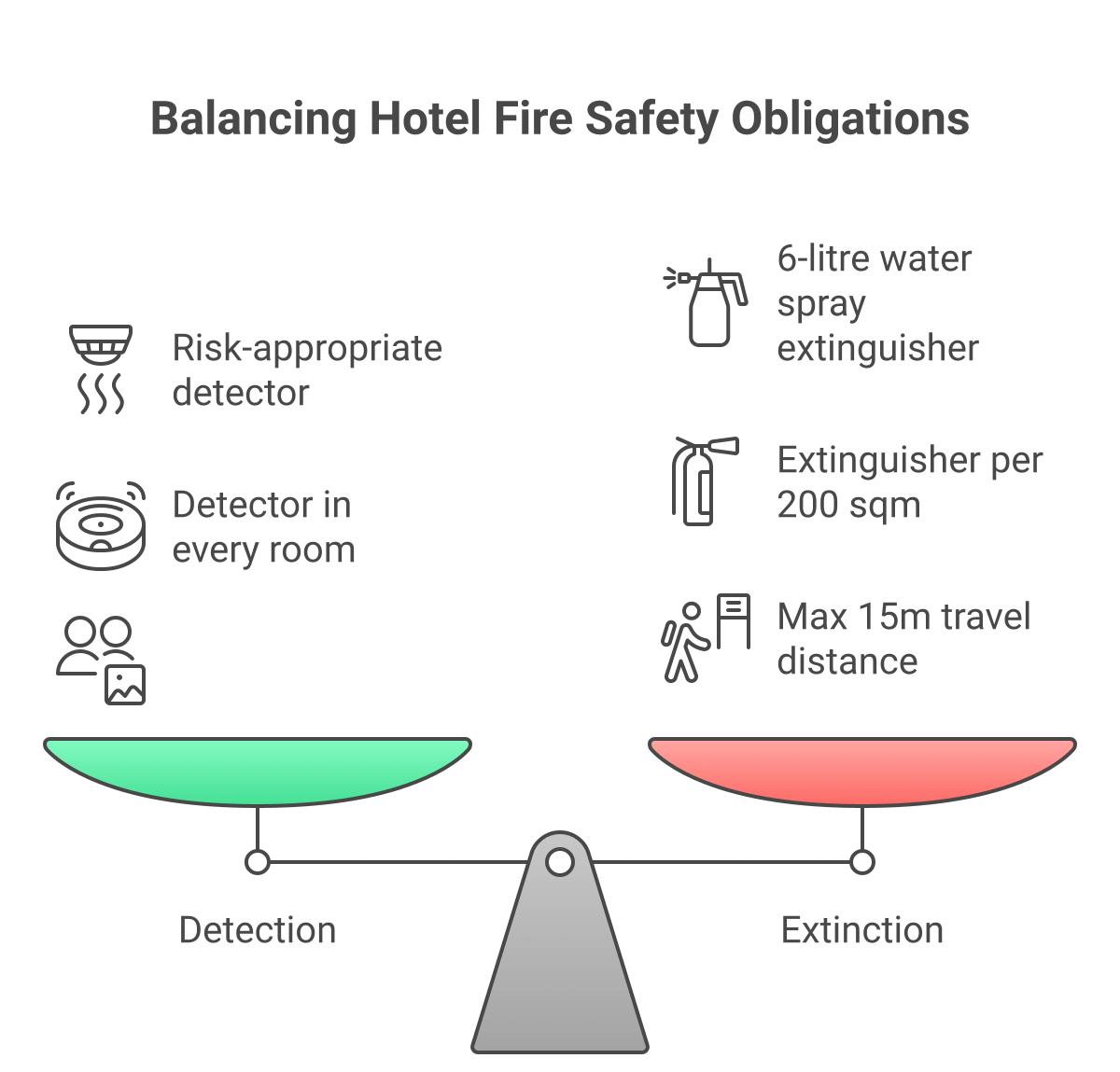
Detection and firefighting means in every room
The Article O 19 §2 of the fire safety regulation requires detectors suited to the risk in every room or apartment. The exact detection type and its placement depend on the layout of the premises and should be validated with a qualified installer or an inspection body.
Article O 17 of the fire safety regulation requires water-spray extinguishers of at least 6 litres, sensibly distributed at a minimum of one per 200 m², positioned so the distance to reach one never exceeds 15 metres, plus additional equipment suited to specific risks (kitchen, technical rooms). The extinguisher type chosen depends directly on the nature of the risk covered, which makes a prior risk analysis essential.
Safety instructions and evacuation plan displayed in every room
The Article O 21 §2 of the fire safety regulation requires a fire safety instruction, compliant with the regulatory model and illustrated with a comic-strip layout, to be displayed in every room or apartment, along with an evacuation plan compliant with standard NF S 60-303 on each floor.
A missing safety instruction or non-compliant evacuation plan in the rooms can be flagged during a safety commission visit and contribute to an unfavorable opinion, with a mandatory remediation before any reopening or continued operation.

Centralize your hotel's compliance tracking
CompliAssist continuously tracks your establishment's ERP (and ICPE, where applicable) obligations and calculates your ScoreRisk: the documented proof to present to the safety commission or your inspection body.
Technical checks: what Article O 22 covers
Article O 22 §4 of the fire safety regulation refers to the cross-cutting technical checks applicable to any ERP: smoke extraction, heating, gas, electricity, lighting, elevators and firefighting resources. These checks, along with their dates and results, must be recorded in the establishment's safety register.
Depending on the type of installation and the hotel's category, these checks fall to either competent technicians or accredited bodies whose role is set by regulation, notably for new or modified installations before reopening.
2026 update: triennial verification now covers 5th-category hotels
The decree of 1 December 2025 amending the decree of 25 June 1980 extends to 5th-category establishments, a status that covers a large share of independent hotels, the obligation to have the establishment's technical installations and equipment, heating, lighting, electrical installations, gas installations, elevators and firefighting resources, verified every three years at most by competent technicians. These provisions, set out in Article PE 4, came into force on 1 July 2026, alongside a systematic check of new or modified gas installations before the establishment reopens.
Among the businesses CountAct works with, one regulatory obligation in four is missed or poorly documented when tracked only through a spreadsheet. Technical verification deadlines are no exception, particularly for multi-site establishments.
Hotel fire safety compliance: two ways to prepare
| Documented tracking (up-to-date register, ScoreRisk) | Paper or standalone spreadsheet tracking | |
|---|---|---|
| Safety commission visit | File available immediately, dated history | Document search under pressure, risk of unfavorable opinion |
| Triennial installation verification (Art. PE 4, from 2026) | Deadlines tracked per establishment | Deadline easily missed, especially across multiple sites |
| Proof of gas, electrical and firefighting resource checks | Centralized reports, accessible to the competent technician | Documents scattered across different contractors |
| Multi-establishment overview | A single indicator (ScoreRisk) per site | Manual reconstruction site by site |
What to keep in mind before digitizing your tracking
In-room detection, firefighting means, displayed instructions, regular technical checks: these obligations form a coherent baseline, reinforced for 5th-category hotels by the triennial verification that came into force in 2026. A tool like ScoreRisk, part of CompliAssist, formalizes this tracking continuously, without replacing the safety commission, an accredited inspection body, or a competent technician.
Nothing in this article constitutes personalized legal advice. Only the safety commission, an accredited inspection body, or a legal professional can precisely assess your establishment's situation.
SécuQuiz
Test your knowledge of hotel fire safety
Question 1 sur 4
A hotel falls under the same regulatory regime regardless of how many people it can accommodate.
Sources & references
- Chapter IV: Type O establishments, hotels (Articles O 1 to Annexe II) — Légifrance
- Article O 17 - Decree of 25 June 1980 (firefighting means) — Légifrance
- Article O 21 - Decree of 25 June 1980 (safety instruction and evacuation plan) — Légifrance
- Article O 22 - Decree of 25 June 1980 (technical checks) — Légifrance
- Article PE 4 - Decree of 25 June 1980 (5th category, triennial verification) — Légifrance
- Decree of 1 December 2025 amending the decree of 25 June 1980 — Légifrance / Journal officiel
Frequently asked questions
Tom BasinStrategic Partnerships Manager
Holding a Master's degree in risk prevention, Tom Basin serves as Partnerships Manager at CountAct, contributing to the development and rollout of the first turnkey crisis management support solution, with the aim of putting security back at the heart of businesses. His experience, along with his training at the Master's level and at the Institut national des hautes études de la sécurité et de la justice, gives him a broad perspective on security and crisis management.