
ERP Safety Register: Mandatory Content and How Often to Update It
The safety register: a mandatory document for every ERP
As soon as a French establishment receiving the public (ERP - Établissement Recevant du Public) opens its doors, it must hold a safety register ("registre de sécurité"). Kept by the operator or the person in charge of the establishment, this document centralizes the evidence that the site meets its fire-safety obligations. It is presented to the safety commission at every visit, and authorities can request it at any time.
The safety register should not be confused with the DUERP (the occupational risk assessment document): the safety register is specific to ERPs and covers fire safety, while the DUERP covers occupational risk assessment for all employees.
Two distinct obligations, two different scopes: the safety register stems from the Construction and Housing Code (ERPs, fire safety), while the DUERP stems from the Labour Code (every employer, occupational risks). The same site can be subject to both at once.
What must the safety register contain? (Article R143-44)
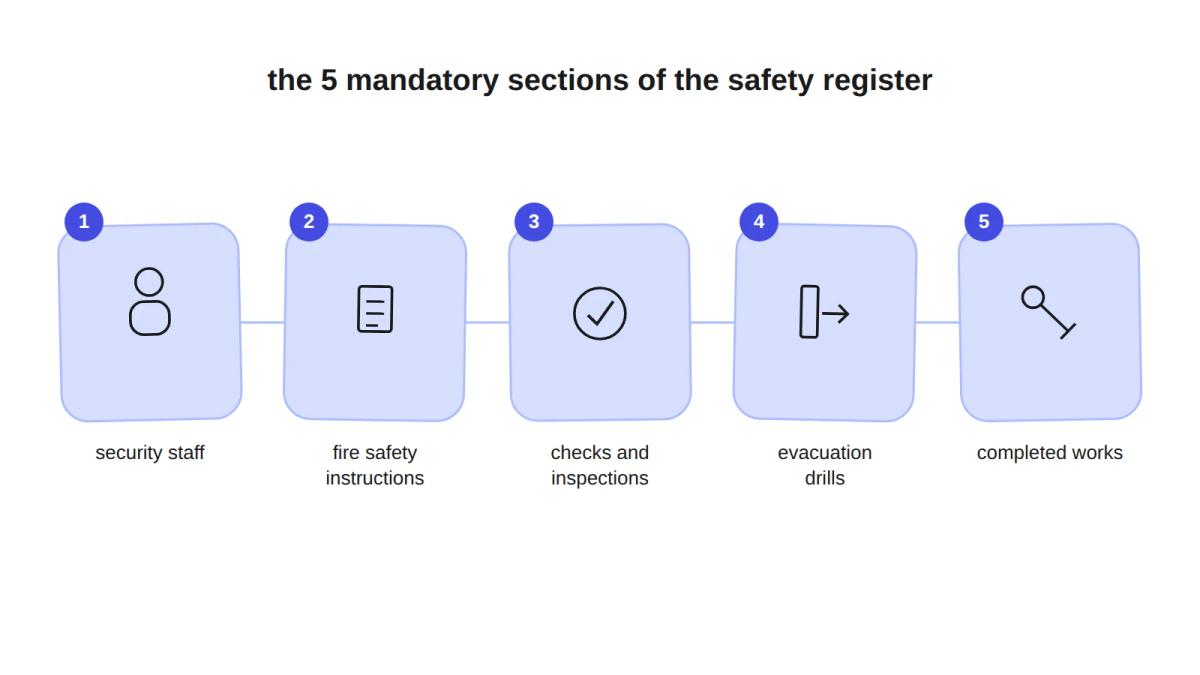
The mandatory content of the safety register is set out in Article R143-44 of the Construction and Housing Code (formerly Article R123-51). It must cover five categories of information:
- The named and hierarchical list of the fire-safety service staff.
- The general and specific fire instructions, including evacuation instructions that take different types of disability into account.
- The dates of technical checks and inspections, along with the resulting observations.
- The dates of fire-safety (evacuation) drills.
- The dates and nature of fitting-out or alteration works, with the name of the contractor(s) and, where applicable, the architect.
What changed on July 1, 2026: equivalent-effect solutions
Decree No. 2025-1100 of November 19, 2025 introduced "equivalent-effect solutions" (solutions d'effet équivalent, SEE), which allow project owners to depart from prescriptive fire-safety rules as long as an equivalent level of safety is demonstrated. Since July 1, 2026, whenever an ERP uses such a solution, the safety register must include the corresponding file: the nature and design of the solution, compliance attestations against the safety objectives, and tracking of any subsequent changes.
This regulatory change is very recent. If your establishment uses, or plans to use, an equivalent-effect solution, have the register-integration details validated by your inspection body or the competent safety commission - implementation practice is still settling.
How often must the safety register be updated?
Article R143-44 sets no fixed update frequency for the register itself: every event (check, inspection, drill, works) must be logged as it happens. The "frequency" people usually have in mind actually refers to the periodic visits of the safety commission, set out in Article GE 4 of the decree of June 25, 1980, during which the register itself is checked.
- 1st- to 4th-category ERPs: periodic safety commission visit every 3 or 5 years depending on the establishment type (periodicity table in Article GE 4).
- 5th-category ERPs with overnight accommodation (hotels, residences, hostels...): periodic visit every 5 years.
- 5th-category ERPs without overnight accommodation: since Decree No. 2025-1100 of November 19, 2025, these establishments are no longer subject to a systematic periodic visit.
The absence of a mandatory periodic visit does not exempt you from keeping the register up to date: it remains enforceable at any time, in particular during an unannounced inspection or after an incident.
Who fills in and who checks the safety register?
Keeping the register up to date is the responsibility of the operator or the person in charge of the establishment, as part of their broader safety obligation. During its visit, the safety commission checks that the register is complete and up to date; its own observations are then logged in the register in turn.
This covers the general framework: for how it applies to a specific establishment (category, activity, layout of the premises), check with an inspection body, your insurer, or the locally competent safety commission.
Two points of the register deserve particular attention: how a security visit from the commission unfolds and is prepared, and how technical checks are carried out by accredited bodies - see the role of certification bodies for more detail.
In practice: the gaps most often flagged during inspections
During safety commission visits, the same gaps come up again and again: a security staff list that was not updated after someone joined or left, technical inspection dates logged on a separate document (and therefore missing from the register on inspection day), or an evacuation drill that was carried out but never formally logged. These omissions do not call the site's actual safety into question, but they are systematically flagged by the commission and can delay clearing an unfavorable opinion.
- Update the security staff list every time a role changes, not just once a year.
- Log each technical inspection the same day it happens, with the reference of the body that carried it out.
- File each evacuation drill report (duration, headcount, observations) directly in the register rather than in a separate file.
- Before any commission visit, check that recent works are logged in the register with their dates.
Moving off paper with a solution like CompliAssist
A register kept on loose sheets or in a spreadsheet multiplies the risk of missed entries and complicates preparation for a commission visit. CompliAssist, CountAct's application dedicated to property security, centralizes tracking of ERP and ICPE regulatory obligations: ScoreRisk gives an instant view of your compliance level, checks and inspections are logged automatically, and the generated reports help both prepare for a visit and negotiate better terms on your property damage insurance.

Centralize your ERP obligation tracking
See how CompliAssist digitizes regulatory tracking, from the safety commission visit to a continuously up-to-date register.
SécuQuiz
Test your knowledge of the ERP safety register
Question 1 sur 4
Under Article R143-44 of the Construction and Housing Code, what must the safety register contain?
Sources & references
Frequently asked questions
Tom BasinStrategic Partnerships Manager
Holding a Master's degree in risk prevention, Tom Basin serves as Partnerships Manager at CountAct, contributing to the development and rollout of the first turnkey crisis management support solution, with the aim of putting security back at the heart of businesses. His experience, along with his training at the Master's level and at the Institut national des hautes études de la sécurité et de la justice, gives him a broad perspective on security and crisis management.