
ERP Safety Commission: How It Works, Which Categories Are Affected, and What an Unfavorable Opinion Means
What is the safety commission, and who sits on it?
The safety commission that inspects your ERP (establishment receiving the public) is, in most cases, a local branch of the departmental advisory commission for safety and accessibility (CCDSA), created by Decree No. 95-260 of March 8, 1995. Depending on the size of your municipality, it takes the form of a district, municipal, or inter-municipal commission, but its composition is governed by the same text.
It brings together the prefect or their representative (who chairs it), a representative of the departmental fire and rescue service (SDIS), the departmental territorial directorate, the police or gendarmerie, and local elected officials: mayors and departmental councillors. For accessibility matters, representatives of disability advocacy associations also sit on the commission.
The commission's opinion is advisory only: it does not legally bind the police authority (the mayor, or the prefect for certain ERPs). The mayor makes the final decision to authorize opening, refuse it, or order a closure; the commission informs that decision, it does not replace it.
Which ERP categories are affected, and how often?
All 1st- to 4th-category ERPs are subject to the safety commission's periodic visits. The exact frequency depends on the type of establishment and whether it includes overnight accommodation (hotels, lodging facilities, healthcare establishments): Article GE 4 of the Decree of June 25, 1980 sets periodicities ranging from 2 years for establishments with accommodation up to 5 years for certain ERPs without accommodation that received two consecutive favorable opinions. The exact table by activity type (type L, M, N, O, R...) is available on Légifrance; if you're unsure which periodicity applies to your establishment, your local SDIS or an accredited inspection body can confirm it.
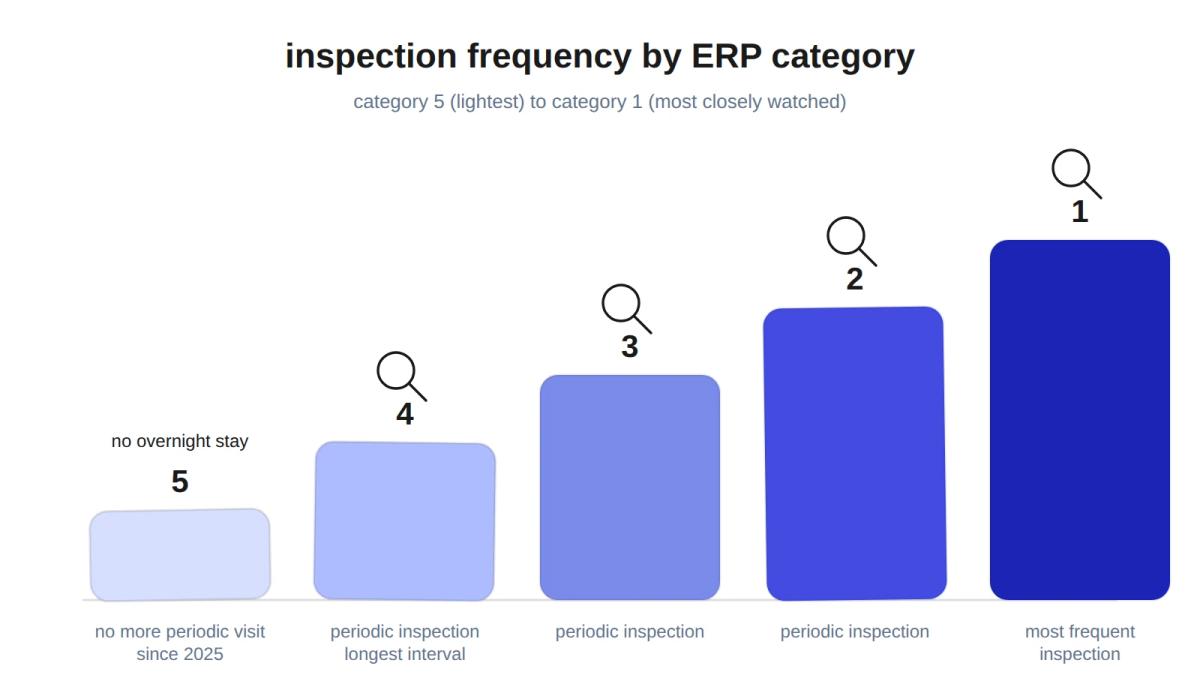
Since Decree No. 2025-1100 of November 19, 2025 (in force since November 21, 2025, with some provisions applying from July 1, 2026 and January 1, 2027), 5th-category ERPs without overnight accommodation (small shops, public-facing offices, small practices) exit the fire-safety opening authorization regime and the commission's periodic visits. A simple description of the safety measures taken is now submitted to the police authority for information only. If your establishment is close to the 4th/5th-category threshold, confirm its exact classification before assuming this change applies to you.
How does a commission visit actually unfold?
The visit happens in three stages. First, notice: the operator is informed of the date, usually several weeks ahead for a periodic visit (acceptance visits after construction work or before opening follow a different schedule, tied to the progress of the works). Next, the on-site visit: commission members examine escape routes, smoke extraction, electrical installations, firefighting equipment, and above all the paperwork: an up-to-date safety register, inspection reports from accredited certification bodies, evacuation drill records.
Finally, deliberation: the commission issues its opinion during or shortly after the session, and the report is forwarded to the mayor. This commission process should not be confused with the workplace security visit, which more broadly covers occupational risk prevention at the workstation level, beyond fire risk alone.
On the day of the visit, the documents most commonly requested are the safety register, the latest regulatory inspection reports (electrical, smoke extraction, firefighting equipment), and the record of the last evacuation drill. Keeping them centralized and up to date ahead of time avoids most of the reservations a commission raises.

Is your safety register ready for the next visit?
CompliAssist centralizes your safety register, inspection reports, and regulatory deadlines in a single dashboard, with a ScoreRisk indicator showing your compliance level at a glance.
The three types of opinion, and what an unfavorable opinion means
The commission can issue three types of opinion: favorable, favorable with requirements (work or measures to complete within a set deadline), or unfavorable. An unfavorable opinion flags a shortfall considered serious enough to call the establishment's continued operation into question as it stands; it does not itself order a closure.
It's the mayor (or the prefect, depending on the case, under their police powers) who decides what happens next: a formal notice to complete corrective work or measures within a set deadline, then, absent compliance, a possible administrative closure. If the mayor does not act despite an unfavorable opinion, the prefect can step in instead. The operator can challenge the mayor's decision before the administrative court, but not the commission's opinion itself, which is merely advisory and is not a decision that can be directly challenged.
This vigilance fits into the broader employer's safety obligation, which covers the site's entire scope of occupational risk, well beyond the fire risk regulated by the Construction and Housing Code alone.
This description stays general: the concrete application (formal-notice deadlines, exact nature of corrective measures, appeal routes) depends on your specific situation and the text applicable to your establishment. If you receive an unfavorable opinion, contact your SDIS, an accredited inspection body, or a specialized lawyer quickly to secure your path to compliance.
How to avoid an unfavorable opinion: what CompliAssist tracks for you
Most unfavorable opinions or reservations stem from the same recurring causes: an incomplete or missing safety register, an expired inspection report, an undocumented evacuation drill, or a missing prevention plan for an outside contractor's work. CompliAssist centralizes these elements: ScoreRisk, tracking of ERP, ICPE, and Seveso obligations, safety register, fire permits, and generates automatic reports and dashboards, so you arrive at the commission with a complete file instead of scattered spreadsheets.
Test your regulatory compliance level
CountAct's free compliance audit spots missing or poorly documented ERP, ICPE, or Seveso obligations in minutes, before your next commission visit.
SécuQuiz
Test your knowledge of the ERP safety commission
Question 1 sur 4
Who makes the final decision after an unfavorable opinion from the safety commission?
Sources & references
- Decree No. 95-260 of March 8, 1995 on the departmental advisory commission for safety and accessibility — Légifrance
- Articles R.143-1 to R.143-47 of the French Construction and Housing Code — Légifrance
- Article GE 4 - Decree of June 25, 1980 (ERP fire safety regulation) — Légifrance
- Decree No. 2025-1100 of November 19, 2025 — Légifrance
- Article L.4121-1 of the French Labor Code — Légifrance
Frequently asked questions
Tom BasinStrategic Partnerships Manager
Holding a Master's degree in risk prevention, Tom Basin serves as Partnerships Manager at CountAct, contributing to the development and rollout of the first turnkey crisis management support solution, with the aim of putting security back at the heart of businesses. His experience, along with his training at the Master's level and at the Institut national des hautes études de la sécurité et de la justice, gives him a broad perspective on security and crisis management.