
ERP Categories 1 to 5: Which Obligations Actually Change
ERP category and type: two different criteria, not to be confused
A French ERP (establishment open to the public) is defined by two distinct criteria: its type, which reflects the nature of its activity (M for a shop, N for a restaurant, J for a facility housing elderly or disabled residents, etc.), and its category, which reflects the size of the establishment as measured by its occupancy. The two combine: one restaurant can be type N and category 3, another type N and category 5. It is the category, not the type, that drives most of the obligations covered in this article.
For a full overview of workplaces open to the public, see our dedicated article on fire safety obligations for ERT workplaces.
How an ERP's category is calculated: the thresholds in Article R143-19
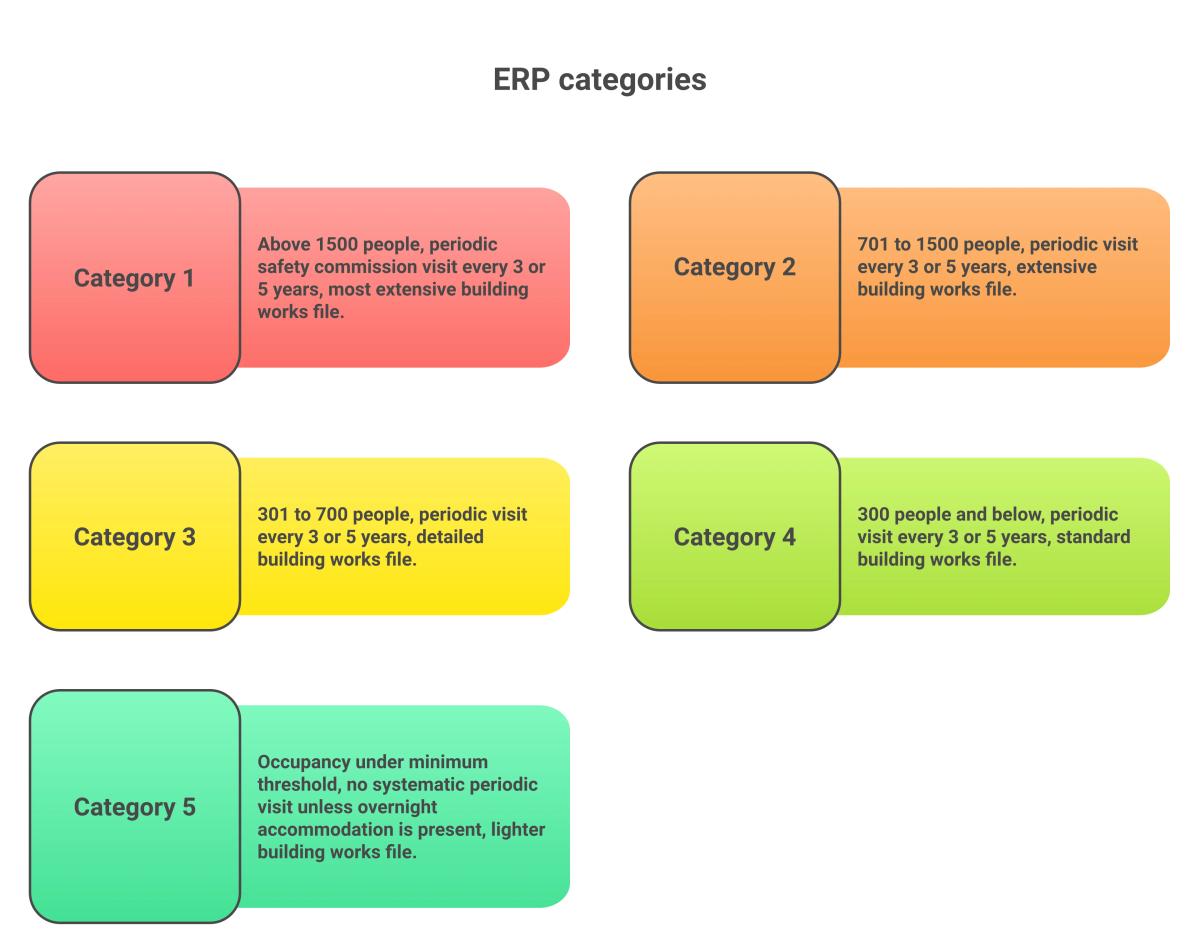
Article R143-19 of the French Construction and Housing Code sets five categories, calculated from the public headcount and, depending on the safety regulation applicable to the establishment's type, staff:
- 1st category: above 1,500 people.
- 2nd category: 701 to 1,500 people.
- 3rd category: 301 to 700 people.
- 4th category: 300 people and below, except establishments classified in the 5th category.
- 5th category: establishments where the public headcount does not reach the minimum threshold set by the safety regulation for each type of operation (for example 200 people for a type M shop).
Categories 1 to 4 are sometimes grouped under the term "large establishments", the 5th category under "small establishments". This distinction shapes most of the obligations covered below.
What actually changes based on category
How often the safety commission visits
Establishments in categories 1 to 4 are subject to a periodic safety commission visit (Article R143-41 of the Construction and Housing Code), every 3 or 5 years depending on the type and category. 5th-category establishments without overnight accommodation have been exempt from this periodic visit since Decree No. 2025-1100 of November 19, 2025: oversight then relies on self-declaration and possible unannounced visits, not a fixed calendar deadline. For a full walkthrough of these visits, see our article on the ERP safety commission.
The file required for building works
The safety file to attach to a building works authorization request (safety notice, plans, technical notice) scales with the category: more detailed for categories 1 to 3, sometimes with several distinct technical documents, simpler for categories 4 and 5. The exact content also depends on the establishment's type; have it validated by an inspection body or your local fire department's prevention office before filing.
The safety register's content: identical across every category
Contrary to a common assumption, the safety register's required content, set by Article R143-44, does not vary by category: security staff, instructions, checks, drills, works, every establishment open to the public must log the same items from the day it opens. Our dedicated article details this mandatory register content.
The special case of ERPs with overnight accommodation
Establishments with accommodation (nursing homes, hotels, shelters) remain under stricter oversight regardless of category: the periodic safety commission visit applies to every ERP with overnight accommodation, including 5th-category ones, because people sleep there rather than just visiting during the day. See our dedicated articles on nursing home fire safety (type J) and hotel fire safety (type O).
Tracking categories across multiple sites: two scenarios
Across a portfolio of several establishments, mixing categories and types in a spreadsheet raises the risk of missing a deadline.
| Centralized tracking (CompliAssist) | Site-by-site spreadsheets | |
|---|---|---|
| Tracking categories and types per site | One record per establishment, centrally updated | Scattered spreadsheets, unsynchronized versions |
| Alert ahead of a periodic visit deadline | Automatic reminder based on the applicable frequency | Depends on each local manager's vigilance |
| Proof in case of inspection | Dated, searchable history (ScoreRisk) | After-the-fact reconstruction, often incomplete |

Centralize tracking across your multi-site ERPs
CompliAssist links every establishment to its category and regulatory deadlines, and calculates your ScoreRisk continuously.
What this means in practice for a multi-site manager
Across a mixed portfolio (shops, offices, warehouses), each site's category drives a different inspection calendar. Two practical habits help: consolidate each establishment's category, type, and last visit date into a single document, and re-check that classification after any change in headcount or layout, since an establishment's category can change.
A concrete example: a shopping center whose peak-hour footfall grows from 650 to 750 visitors crosses the 700-person threshold and moves from 3rd to 2nd category. That shift alone triggers a different periodic-visit rhythm and a more substantial building works file for the next extension, even though the establishment's activity and type stay the same.
SécuQuiz
Test your knowledge of ERP categories
Question 1 sur 4
A 3rd-category ERP has an occupancy of:
Sources & references
- Article R143-19 - French Building and Housing Code — Légifrance
- Article R143-41 - French Building and Housing Code — Légifrance
- Article R143-44 - French Building and Housing Code — Légifrance
- Decree No. 2025-1100 of November 19, 2025 (periodic visits and equivalent-effect solutions) — Légifrance / JORF
Frequently asked questions
Tom BasinStrategic Partnerships Manager
Holding a Master's degree in risk prevention, Tom Basin serves as Partnerships Manager at CountAct, contributing to the development and rollout of the first turnkey crisis management support solution, with the aim of putting security back at the heart of businesses. His experience, along with his training at the Master's level and at the Institut national des hautes études de la sécurité et de la justice, gives him a broad perspective on security and crisis management.