
The Occupational Risk Assessment (ORA)
In today's dynamic world of work, worker safety and health are paramount concerns for businesses. Every occupational risk must be dissected, assessed and reduced. Occupational risk assessment (ORA) thus emerges as an essential pillar of workplace safety management. This practice aims to identify, assess and control the hazards present in the working environment of all employees. In this article, we will explore the importance of occupational risk assessment (ORA), its methods, and practical advice.
What is occupational risk assessment (ORA)?
Occupational risk assessment (ORA) consists of identifying and classifying the risks that may arise within a company, in order to implement relevant, consistent and appropriate prevention actions. Every occupational risk must be taken into account. It is the initial step of any prevention approach. Following the occupational risk assessment (ORA), the information is recorded in the single occupational risk assessment document (DUERP). On this topic, we have a free single risk assessment document template in PDF format.
Why implement an occupational risk assessment (ORA)?
As an employer, you have the obligation to ensure the safety and to protect the health of your employees. Occupational risk assessment (ORA) gives you the means to exercise this responsibility. Occupational risk assessment is among the general prevention principles set out in the French Labor Code: (Articles L.4121-2 and L.4121-3). This includes actions to identify and classify risks, as well as to implement prevention actions for each occupational risk.
As an employer, failing to properly assess and document occupational risks can expose you to legal liability in the event of a workplace accident, as well as potential fines. Keeping your risk assessment accurate and up to date is a core part of your duty of care toward employees.
What are the occupational risks?
There is a multitude of occupational risks. We have compiled a list of occupational risks, which we recommend you check out here.
How to carry out an occupational risk assessment (ORA)?
1) Identify the hazards
Start by identifying all the potential hazards present in the workplace that represent a potential occupational risk. This may include:
Physical hazards (machinery, equipment)
Chemical risks (hazardous substances)
Biological risks (pathogens)
Ergonomic risks or MSDs (poor posture, handling of heavy loads)
Psychosocial risks (stress, harassment).
2) Assess and rank the risks
Once the hazards have been identified, assess the likelihood that these hazards will materialize and the extent of the damage they could cause. Use tools such as risk matrices to assign likelihood and severity levels to each hazard. You can then establish a ranking of your risks. Assessing and ranking risks relies on fundamental criteria such as the frequency, severity, and detectability of these risks. This ranking will allow you to set up an action plan for each occupational risk by prioritizing risks according to their position in the ranking, which results from their severity, the extent of the damage they could cause, and so on. CountAct has predefined templates to help you in this process. Feel free to contact us for more information!
3) Determine and implement control measures
Based on the risk assessment, identify the appropriate control measures to reduce or eliminate these risks. Control measures may include:
Technical modifications (for example, installing guards on machines)
Organizational changes (for example, implementing task rotation to reduce workload)
Administrative measures (for example, training employees on safety procedures).
Once the control measures have been determined, implement them as part of the company's daily operations. Make sure that all employees concerned are informed of the new procedures and trained in their implementation. Also make sure to record all the occupational risk assessment (ORA) information in your single occupational risk assessment document (DUERP)! On this topic, if needed, we have a free single risk assessment document template in Excel format.
4) Monitoring and reassessment
Finally, be sure to regularly monitor the effectiveness of the control measures implemented and reassess each occupational risk periodically or whenever new hazards are identified. This ensures that the risk assessment remains relevant and that the control measures remain effective in a constantly evolving work environment. To monitor the measures implemented, we recommend setting up performance indicators. These will allow you to track progress based on concrete data and to monitor developments with ease. CountAct simplifies this process by providing an intuitive solution that automates data collection, offers real-time analysis and generates relevant reports. By following these steps, companies can establish a robust and effective occupational risk assessment process to ensure the safety and health of their employees in the workplace. The occupational risk assessment will then be transcribed into the Single Occupational Risk Assessment Document (DUERP). CountAct offers a free single risk assessment document template in Excel format as well as a single risk assessment document template in PDF format. Feel free to contact us through our website by clicking here! You can also use the tool set up by the CNRS for assessing your occupational risks (CNRS ORA). Tip: To make this process easier for small and medium-sized businesses, there are simple-to-use online tools, tailored by industry sector or occupation, offered by INRS!
How to fill out an occupational risk questionnaire?
Here are a few tips to follow when filling out your occupational risk assessment questionnaire for the first time:
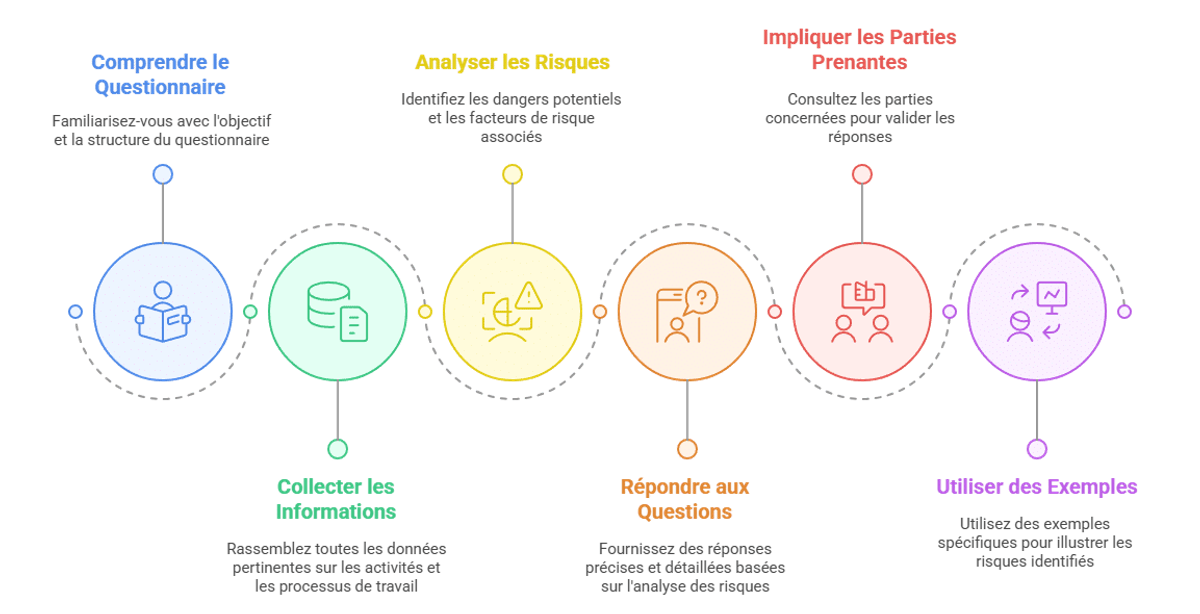
If you encounter difficulties in setting up this process, or simply don't know where to start, CountAct will be happy to assist you! Feel free to contact us by booking an appointment directly through our website! You can also use the tool set up by the CNRS for assessing your occupational risks (CNRS ORA).
Need help structuring your occupational risk assessment?
CountAct helps you identify hazards, rank risks, and track control measures in one place, so you never have to start your ORA from a blank page.
Who can take part in the occupational risk assessment (ORA) process?
The occupational risk assessment process is a collaborative process that requires the active participation of all stakeholders in the company.
First of all, the employer is responsible for ensuring that the occupational risk assessment is carried out properly.
Employees play a crucial role in assessing each occupational risk. Indeed, they can identify potential hazards in their daily working environment.
Likewise, staff representatives such as a social and economic committee (CSE) or a health, safety and working conditions committee (CHSCT). They must be involved in the risk assessment process to defend workers' interests.
Of course, safety officers such as occupational health and safety (OHS) managers, prevention officers, or members of the risk management team, play a key role in coordinating the assessment of each occupational risk and in implementing control measures.
Finally, it is possible to call on external service providers who are experts in health and safety. They will provide you with specialized advice on specific risks or complex situations.
It is important to remember that the occupational risk assessment (ORA) process needs to be regularly updated! To do this, we recommend regularly conducting safety inspections. This will ensure that you always keep your single occupational risk assessment document (DUERP) optimally up to date. As mentioned earlier, CountAct offers a free single risk assessment document template in Excel format. We also offer a single risk assessment document template in PDF format. If you are interested, you can contact us directly through our website by clicking here! Also, don't forget to make use of the CNRS tool for assessing your occupational risks (CNRS ORA). In conclusion, occupational risk assessment (ORA) is essential to ensure the safety and health of workers. This process makes it possible to identify, assess and control potential hazards in the workplace, all in order to create a safe and sustainable working environment for all employees.
SécuQuiz
Test your knowledge on Occupational Risk Assessment
Question 1 sur 5
What document records the results of the Occupational Risk Assessment (ORA)?
Sources & references
- L’évaluation des risques professionnels (EvRP) — www.cnracl.retraites.fr
- document unique d’évaluation des risques pdf. — calendar.google.com
- l’obligation d’assurer la sécurité et de protéger la santé de vos salariés — www.droit-travail-france.fr
- articles L.4121-2 — www.legifrance.gouv.fr
- L.4121-3 — www.google.fr
- risques chimiques — www.inrs.fr
- risques biologiques — www.inrs.fr
- proposés par l’INRS — www.inrs.fr
Frequently asked questions
Tom BasinStrategic Partnerships Manager
Holding a Master's degree in risk prevention, Tom Basin serves as Partnerships Manager at CountAct, contributing to the development and rollout of the first turnkey crisis management support solution, with the aim of putting security back at the heart of businesses. His experience, along with his training at the Master's level and at the Institut national des hautes études de la sécurité et de la justice, gives him a broad perspective on security and crisis management.