
The Internal Organization Plan
Mandatory since January 1, 2023 for high-risk industrial facilities, the Internal Organization Plan is strongly recommended for every company. Indeed, implementing an Internal Organization Plan (IOP) for crisis management is essential to ensure business continuity in the event of a crisis. It defines the organization to be activated during an emergency situation. Today, our solution CountAct fits perfectly into your implementation of an IOP. It even strengthens and reinforces it. Indeed, our digital tool available 24/7 lets you trigger an IOP and have everything at hand even during on-call duty. By having an IOP for crisis management in place, the company is prepared to effectively handle an emergency situation. This helps minimize damage. Without an adequate IOP, a company can expose itself to significant financial and reputational risks. The main challenge is not to miss the first actions to be taken. The goal: not to worsen the ongoing crisis (disaster, gas leak, malicious intrusion, etc.). Do you already have an internal IOP? Is it up to date? In this article, we will look in detail at how to set it up, its usefulness, and when it should be updated to ensure its effectiveness.
What is an Internal Organization Plan?
An Internal Operations Plan (IOP) is a crisis management tool that describes the measures, methods, and resources needed to respond to a potential accident with environmental consequences. It is the logical continuation of the hazard study and must be developed taking into account the accident scenarios identified in that study. According to Articles L515-41 and R181-54 of the French Environmental Code, the IOP defines the organizational measures, intervention methods, and resources that the operator must implement to protect personnel, populations, and the environment. It includes not only the facility's own resources, but also those of public emergency services, as well as, if necessary, those of neighboring industries and outside companies.
The Internal Organization Plan and regulations
It has been mandatory for upper-tier SEVESO sites and lower-tier sites since January 1, 2023. It may also be made mandatory for any facility classified for environmental protection (ICPE) subject to authorization by prefectural operating permit or ministerial order. It also helps to identify potential risks and implement strategies to manage them effectively.
Le POI est obligatoire depuis le 1er janvier 2023 pour les sites SEVESO seuil haut et, selon les cas, pour les sites seuil bas. Son absence expose l'exploitant à des sanctions et engage sa responsabilité en cas d'accident.
What does an IOP include?
Naturally, an IOP for crisis management can include information on the procedures to follow in the event of a crisis, the communication protocols for informing the neighboring population, employees, and stakeholders. As well as protocols to minimize damage and resume operations quickly after a crisis. It may also include information on the resources needed to manage a crisis, such as emergency contacts, emergency service providers, and support partners.
How do you build an IOP?
To be effective and easily usable by everyone, the IOP must be a clear and practical document. It should include quick-reference sheets, guides, plans, or other visual documents for better understanding. Generally, the IOP contains at least the following elements:
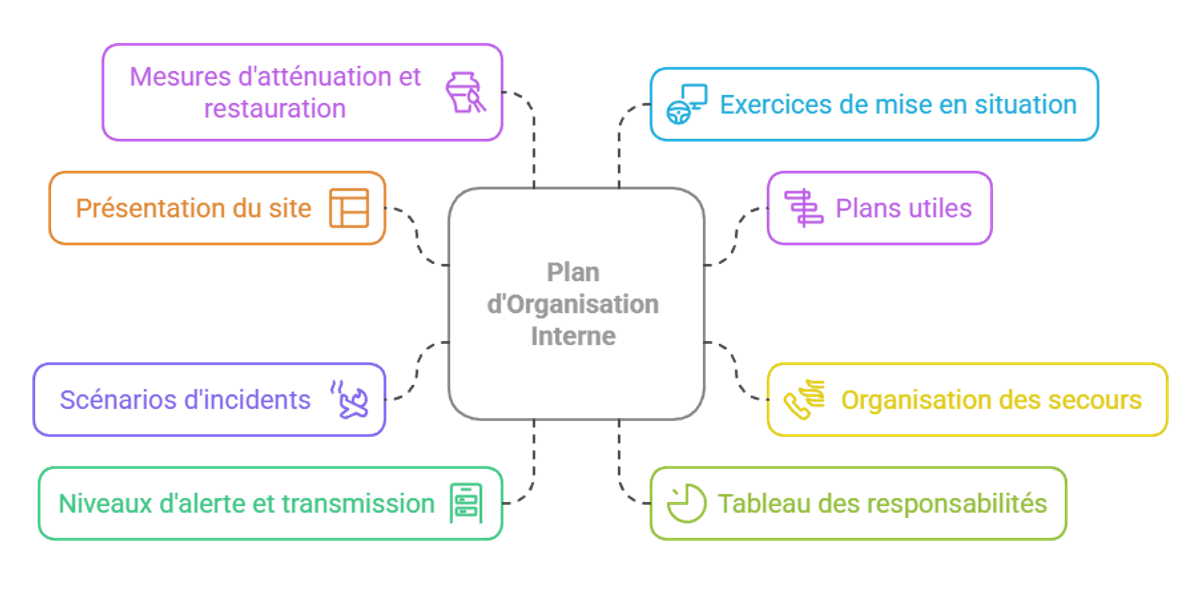
In summary, building an effective Internal Organization Plan (IOP) requires clearly defining the company's objectives and the specific objectives of the IOP. It also requires identifying key processes and defining the roles and responsibilities of each team member. But also, establishing effective communication processes and evaluating and regularly updating the IOP. All of this, to ensure it works as intended and adapts to changes within the company.
When should it be updated?
The Internal Operations Plan (IOP) must be established before facilities are commissioned for upper-tier SEVESO sites, and tested at intervals not exceeding one year, then updated every three years (Article R515-100 of the French Environmental Code). Also, for lower-tier SEVESO sites, drawing up an IOP has been mandatory since January 1, 2023. The plan is tested at least every 3 years, and updated as soon as there is an organizational change.
Who is responsible for implementing the IOP?
In the event of a major incident, it is the responsibility of the facility director, one of their representatives or agents (safety officer) to raise the alarm and trigger the internal operations plan. Also, if the consequences of the incident extend beyond the facility's boundaries, the PPI (specific intervention plan) is also activated. This is an emergency plan designed to manage emergency response resources. This applies beyond the site's boundaries, including, for example, alerting neighboring buildings and residents or the possible evacuation of the area covered by the PPI.
To sum up…
The IOP therefore focuses on controlling "significant and representative" accidents. For example, incidents such as fire, explosion, spillage of liquid products, atmospheric dispersion of toxic substances, etc. For each of these accidents, the following is determined:
- detection methods for the accidents,
- the resources and organization to be implemented to eliminate or limit accidents (extinguishing, containment, etc.),
- the possible extension of the accident to other facilities (including so-called "domino" effects).
Need help setting up an Internal Organization Plan?
We have a PDF guide to help you develop an Internal Operations Plan (IOP); send us an email and we will provide it to you. Also, our CountAct solutiondigitizes your IOP. In summary, implementing an Internal Organization Plan (IOP) for crisis management is crucial. Indeed, it helps ensure business continuity in the event of an emergency or crisis situation. It also helps to define the roles and responsibilities of each team member. As well as the work processes and the objectives to be achieved during a crisis. The goal is to identify potential risks in order to manage them effectively.
Besoin d'aide pour construire votre POI ?
Notre guide PDF détaille étape par étape comment élaborer un Plan d'Organisation Interne conforme et opérationnel. Contactez-nous pour le recevoir.
SécuQuiz
Test your knowledge: Internal Organization Plan (IOP)
Question 1 sur 5
What is the primary purpose of an Internal Organization Plan (IOP)?
Sources & references
- Articles L515-41 and R181-54 of the French Environmental Code — www.legifrance.gouv.fr
- mandatory for upper-tier SEVESO sites — www.legifrance.gouv.fr
- Article R515-100 of the French Environmental Code — aida.ineris.fr
Frequently asked questions
Tom BasinStrategic Partnerships Manager
Holding a Master's degree in risk prevention, Tom Basin serves as Partnerships Manager at CountAct, contributing to the development and rollout of the first turnkey crisis management support solution, with the aim of putting security back at the heart of businesses. His experience, along with his training at the Master's level and at the Institut national des hautes études de la sécurité et de la justice, gives him a broad perspective on security and crisis management.