
Business Property Insurance: What Compliance Traceability Changes in Your Contract
What business property insurance covers, and what it doesn't
Business property insurance (assurance dommages aux biens professionnels) covers material losses related to your activity: fire, explosion, water damage, natural disasters, and sometimes theft or vandalism depending on the options taken. Its exact scope always depends on the contract you sign with your insurer.
Contrary to a common assumption, it isn't mandatory in every case. According to service-public.fr, insurance for rented business premises is a legal obligation for the tenant company, which must cover at least fire, explosion, water damage and natural disasters. Insurance for equipment, machinery and stock remains optional, even though it is in practice almost always included through a commercial multi-risk policy.
The exact obligations vary depending on whether you rent or own your premises, and on the clauses of your commercial lease. This content presents the general framework: have your specific situation validated by your insurer, broker, or a legal professional.
What insurers look at before setting your premium
Before offering you a contract and a price, the insurer asks about the circumstances that let them assess the risk they're taking on: the nature of your activity, revenue, the size and use of your premises, as well as your claims history and the prevention measures already in place. This is known as the risk declaration.
This declaration duty doesn't end when the contract is signed. Article L113-2 of the French Insurance Code requires the policyholder to answer the insurer's questions accurately, then to report any new circumstance that increases the risk during the life of the contract, within fifteen days.
If an omission or inaccurate declaration is unintentional, Article L113-9 of the French Insurance Code provides for a reduction of the indemnity proportional to the gap between the premium paid and the premium that should have been paid. If bad faith is established, Article L113-8 provides for nullity of the contract. Only your insurer or a legal professional can assess your specific situation.
Why compliance traceability changes the picture
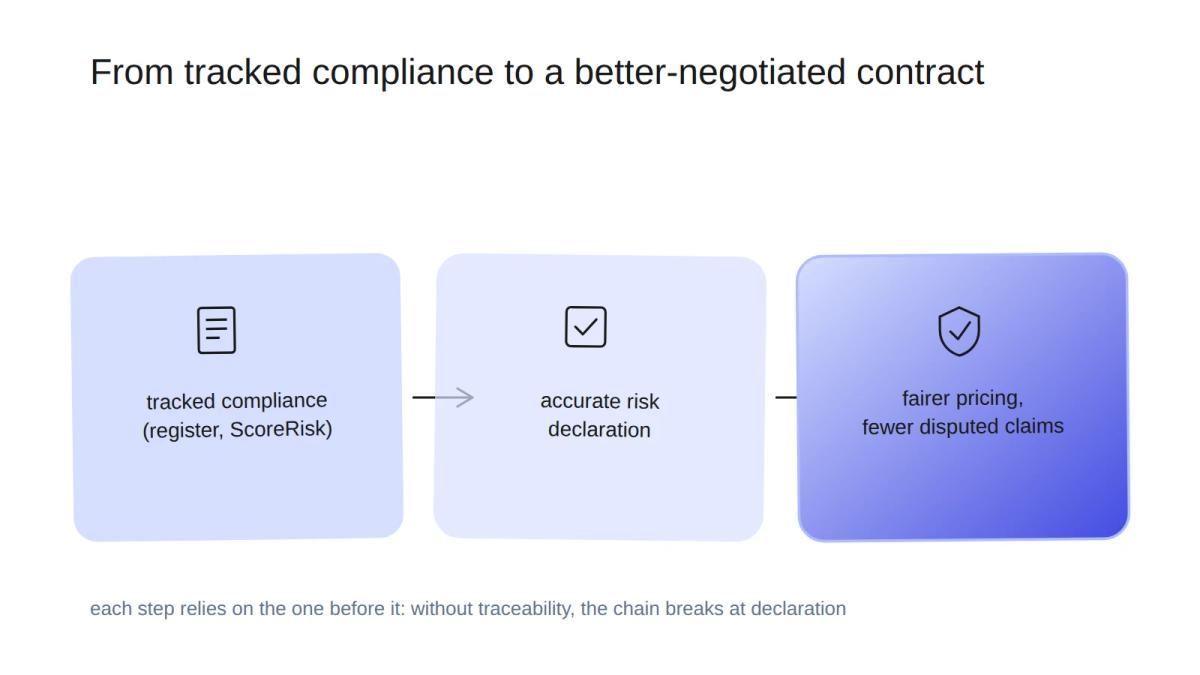
An accurate risk declaration requires knowing, documenting, and being able to prove your own prevention measures. That's exactly what day-to-day regulatory compliance is about: an up-to-date safety register, tracked fire permits, a formalized prevention plan, and ongoing tracking of ERP, ICPE or Seveso obligations depending on your activity.
The safety register, for instance, already centralizes part of the evidence an insurer expects: security staff, technical checks, evacuation drills, and completed works.
This traceability requirement echoes the employer's general safety obligation set out in Article L4121-1 of the French Labour Code, which requires prevention actions, information, and an appropriate organization: an up-to-date compliance file is often the best concrete proof of it.
A tool like our ScoreRisk, part of CompliAssist, formalizes this tracking continuously and produces an indicator you, your inspection body, or your insurer can use. It replaces neither the insurer's own risk survey nor its pricing scale, but it reduces the risk of an omission or approximation in your declaration.

Centralize the traceability of your obligations
CompliAssist tracks your ERP, ICPE and Seveso obligations continuously and calculates your ScoreRisk: the documented proof to present to your insurer.
A claim: what a documented compliance file changes
After a loss, the insurer or their expert checks whether the measures declared at signing actually matched the site's reality. An incomplete register, undocumented evacuation drills, or an untraceable fire permit don't automatically trigger a denied claim, but they weaken your position if the insurer invokes an inaccurate initial declaration.
Compliance file: two scenarios facing a claim
| Documented file (up-to-date register, ScoreRisk) | Incomplete spreadsheet or paper tracking | |
|---|---|---|
| Risk declaration at signing | Based on verifiable, up-to-date data | Based on an estimate, sometimes outdated |
| Proof of prevention measures | Dated, consultable history (register, ScoreRisk) | Hard to reconstruct after the fact |
| Risk of reduced indemnity (Art. L113-9) | Limited if the declaration reflected reality | Higher if a gap is found |
| Negotiating the contract or renewal | Factual case to present to the insurer | Few objective elements to rely on |
Among the businesses CountAct works with, one regulatory obligation in four is missed or poorly documented when tracked only through a spreadsheet. That gap is exactly what an accurate risk declaration is meant to prevent.
Negotiating your contract with the insurer: the right reflexes
Once the documentary foundation is in place, a few reflexes help you negotiate better: identify and prioritize your site's major risks before discussing them with the insurer, lean on existing prevention measures, and involve a broker if your activity is complex (ICPE, Seveso, multi-site).
Identifying the major risks specific to your activity ahead of the discussion with the insurer lets you anticipate their questions instead of discovering them mid-negotiation.
Some businesses already benefit from a comparable mechanism in principle, the CARSAT prevention contract, which funds prevention actions in exchange for measurable commitments: the same traceability logic can be presented to a private insurer.
Nothing in this article constitutes personalized legal or insurance advice. Only your insurer, your broker, or a legal professional can precisely assess your situation and coverage.
SécuQuiz
Test your knowledge of business property insurance
Question 1 sur 4
According to service-public.fr, what must insurance for rented business premises cover at minimum?
Sources & references
- Insuring your business (property and premises) — service-public.fr
- Article L113-2 - French Insurance Code — Légifrance
- Article L113-8 - French Insurance Code — Légifrance
- Article L113-9 - French Insurance Code — Légifrance
- Article L4121-1 - French Labour Code — Légifrance
Frequently asked questions
Tom BasinStrategic Partnerships Manager
Holding a Master's degree in risk prevention, Tom Basin serves as Partnerships Manager at CountAct, contributing to the development and rollout of the first turnkey crisis management support solution, with the aim of putting security back at the heart of businesses. His experience, along with his training at the Master's level and at the Institut national des hautes études de la sécurité et de la justice, gives him a broad perspective on security and crisis management.