
ERT Workplaces: Fire Safety Obligations Under French Labour Law
ERT workplaces: what they are, and why they're not ERPs
An ERT, or établissement recevant des travailleurs, refers to a workplace under the French Labour Code: offices, workshops, warehouses, industrial or office sites employing staff. Article R4227-1 of the French Labour Code specifies that these provisions don't apply to establishments open to the public (ERP), which fall under a separate regime, the French Construction and Housing Code, nor to high-rise buildings.
The same building can be both an ERT for its employees and an ERP for the public it welcomes, with each regime applying in parallel rather than replacing the other. This is typically the case for a shop, a hotel, or a healthcare facility.
Mixing up ERT and ERP obligations is a frequent mistake: a security plan compliant with ERP regulations doesn't exempt the employer from their own Labour Code obligations toward employees, and vice versa.
The foundation: the employer's general safety obligation
Every fire safety obligation detailed in this article stems from a single principle, the employer's general safety obligation set out in Article L4121-1 of the French Labour Code, which requires prevention, information and training actions, along with an organization and resources suited to the establishment's risk.
The firefighting resources required in an ERT
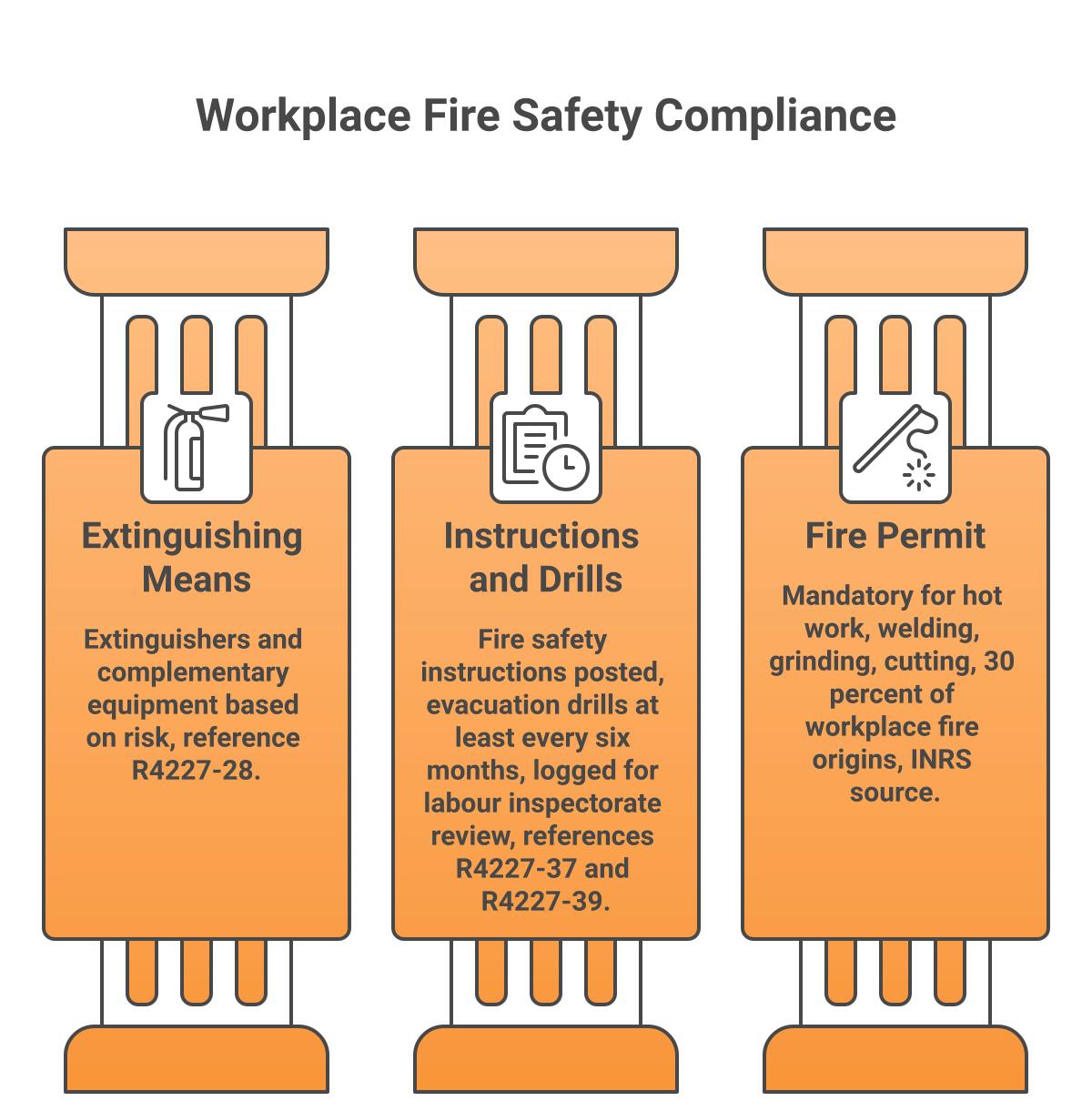
Article R4227-28 of the French Labour Code requires the employer to be able to fight any outbreak of fire quickly and effectively, in the interest of saving workers. In practice, this means extinguishers suited to the nature of the risk, positioned and clearly signposted, plus complementary equipment (fire hose reels, sand reserves) depending on the activity.
Extinguisher types aren't interchangeable: an electrical fire or a flammable-liquid fire isn't handled with the same equipment as a wood or paper fire, which makes a prior risk analysis essential before any purchase.

Centralize your ERT compliance tracking
CompliAssist continuously tracks your Labour Code, ERP, ICPE and Seveso obligations, and calculates your ScoreRisk: the documented proof to present during an inspection.
Fire safety instructions and drills: an obligation that doesn't stop at the poster
Beyond equipment, Article R4227-37 of the French Labour Code requires a fire safety instruction to be displayed very visibly in each relevant premises or passageway, specifying the available equipment, the responsible persons and the procedure to follow.
Article R4227-39 of the French Labour Code goes further: drills and equipment checks must take place at least every six months, with a register kept available to the labour inspectorate recording the dates and observations of each drill.
An incomplete or missing drill register isn't just a formal shortfall: during a labour inspectorate check or after a loss, the absence of documented proof weakens the employer's position, even if drills genuinely took place.
The fire permit: the reference tool for hot work
According to INRS, hot work operations (welding, grinding, cutting) account for 30% of fire origins in businesses. The fire permit specifically governs these operations by formalizing the risk analysis and prevention measures before, during and after the job, following the approach described by INRS in its ED 6030 brochure.
Tracking ERT fire safety obligations: two approaches
| Documented tracking (up-to-date register, ScoreRisk) | Paper or standalone spreadsheet tracking | |
|---|---|---|
| Proof of six-monthly drills (Art. R4227-39) | Dated, consultable history, available to the labour inspectorate | Often scattered, hard to produce during an inspection |
| Tracking of fire permits issued | Centralized and timestamped per job | Paper folder or email, easily lost |
| Multi-site overview | A single indicator (ScoreRisk) per establishment | Manual reconstruction, time-consuming |
| Responsiveness during an inspection | File available immediately | After-the-fact search, under pressure |
Among the businesses CountAct works with, one regulatory obligation in four is missed or poorly documented when tracked only through a spreadsheet. Evacuation drills and fire permits are no exception.
What to keep in mind before digitizing your tracking
These three pillars (extinguishing means; instructions and drills; fire permits) aren't isolated procedures: they all answer the same need for prevention and traceability. A tool like ScoreRisk, part of CompliAssist, formalizes this tracking continuously, without replacing the labour inspectorate, an accredited inspection body, or the advice of a qualified professional for your establishment's specific situation.
Nothing in this article constitutes personalized legal advice. Only the labour inspectorate, an accredited inspection body, or a legal professional can precisely assess your establishment's situation.
SécuQuiz
Test your knowledge of ERT obligations
Question 1 sur 4
An ERT and an ERP fall under the same fire safety regulation.
Sources & references
- Article L4121-1 - French Labour Code — Légifrance
- Article R4227-1 - French Labour Code — Légifrance
- Article R4227-28 - French Labour Code — Légifrance
- Article R4227-37 - French Labour Code — Légifrance
- Article R4227-39 - French Labour Code — Légifrance
- The fire permit - Approach and supporting document (ED 6030 brochure) — INRS
Frequently asked questions
Tom BasinStrategic Partnerships Manager
Holding a Master's degree in risk prevention, Tom Basin serves as Partnerships Manager at CountAct, contributing to the development and rollout of the first turnkey crisis management support solution, with the aim of putting security back at the heart of businesses. His experience, along with his training at the Master's level and at the Institut national des hautes études de la sécurité et de la justice, gives him a broad perspective on security and crisis management.