
EHPAD Fire Safety: The Type J ERP Obligations You Need to Know
EHPAD and type J ERP status: the general framework
A nursing home for dependent elderly people (EHPAD) is classified as a public-access establishment (ERP) of type J once its accommodation capacity reaches roughly 25 residents, under Article J 1 of the fire safety regulation. This regime falls under Chapter XIV of the amended decree of 25 June 1980, which also covers residential facilities for people with disabilities.
As with any ERP, the concrete intensity of the obligations then depends on the establishment's category, determined by the number of people housed. This classification notably sets the frequency of visits from the safety commission.
The threshold of 25 residents and the criteria linked to dependency level (GMP, iso-resource groups) determine whether the type J regime applies, but your establishment's exact category and the resulting inspection frequency should be confirmed by an inspection body or the relevant prevention service.
Automatic detection and alarm: a category A fire safety system
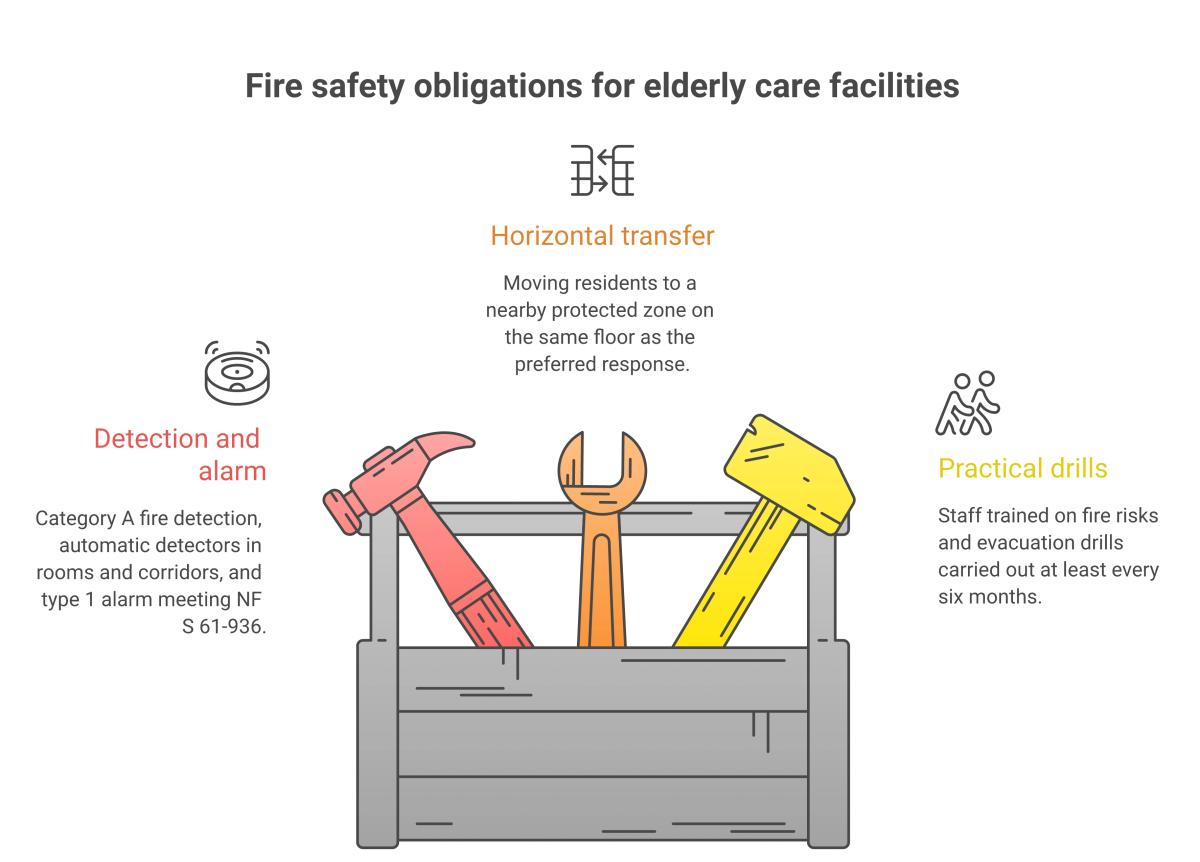
The Article J 36 of the fire safety regulation requires a category A fire safety system in every type J establishment, with automatic detectors suited to the risk installed throughout the establishment, except in stairways and sanitary facilities. Detectors placed in bedrooms must include a visible action indicator from the horizontal corridor, so staff can quickly locate the affected area.
The Article J 37 requires a type 1 alarm system compliant with standard NF S 61-936, able to distribute a selective general alarm across at least one building. Manually triggering the alarm activates the safety asservissements without delay, except for smoke extraction.
Evacuation designed for residents: horizontal transfer
Given residents' reduced autonomy, Article J 3 of the fire safety regulation sets out a principle distinct from other ERP types: from the very start of a fire, the establishment's safety relies on transferring residents horizontally to an adjacent, sufficiently protected zone rather than a general evacuation. Vertical evacuation is only considered in cases of absolute necessity.
This principle requires staff to be present at all times, trained to quickly identify the affected area from detection indicators, and able to carry out this transfer before emergency services arrive, rather than a purely theoretical knowledge of the procedure.

Pilot the horizontal transfer of your residents, zone by zone
EvacApp guides and tracks in real time the evacuation or transfer of people on site, building by building, floor by floor, with no cascade of calls or messages lost.
Firefighting means and semi-annual practical drills
Article J 34 of the fire safety regulation requires water-spray extinguishers of at least 6 litres, sensibly distributed at a minimum of one unit per 200 m² per floor, positioned so the distance to reach one never exceeds 15 metres, plus additional equipment suited to specific risks. The extinguisher type chosen depends directly on the nature of the risk covered.
The Article J 39 requires that all staff receive information on fire hazards and the instructions to follow, supplemented by practical evacuation drills taking place at least once every six months.
A practical drill that took place but was never recorded, or an extinguisher check not renewed on time, can be flagged during a safety commission visit and contribute to an unfavorable opinion, with mandatory remediation before continued operation.
EHPAD fire safety compliance: two ways to prepare
| Documented tracking (up-to-date register, ScoreRisk) | Paper or standalone spreadsheet tracking | |
|---|---|---|
| Safety commission visit | File available immediately, dated history | Document search under pressure, risk of unfavorable opinion |
| Semi-annual practical drills (Art. J 39) | Dates and observations tracked automatically | Paper tracking easily incomplete or misplaced |
| Verification of firefighting means and SSI | Deadlines tracked per establishment | Deadline easily missed, especially across multiple sites |
| Multi-establishment overview | A single indicator (ScoreRisk) per site | Manual reconstruction site by site |
Centralize your EHPAD's compliance tracking
CompliAssist continuously tracks your establishment's ERP obligations and calculates your ScoreRisk: the documented proof to present to the safety commission or your inspection body.
The safety register: documented proof
The Article R143-44 of the Building and Housing Code requires a safety register to be kept, recording the personnel roster of the security department, general and specific evacuation instructions (including for different types of disability), the dates of technical checks and inspections, and the dates of fire safety drills.
What to keep in mind before digitizing your tracking
Category A detection, horizontal-transfer evacuation, extinguishers, semi-annual practical drills and a safety register form a coherent baseline specific to a nursing home's residents with reduced mobility. EvacApp pilots the residents' transfer in real time on the day of an incident, while CompliAssist and ScoreRisk continuously document compliance with these obligations, without replacing the safety commission, an accredited inspection body, or a competent technician.
Nothing in this article constitutes personalized legal advice. Only the safety commission, an accredited inspection body, or a legal professional can precisely assess your establishment's situation.
SécuQuiz
Test your knowledge of EHPAD fire safety
Question 1 sur 4
An EHPAD falls under the same ERP regime regardless of its accommodation capacity.
Sources & references
- Chapter XIV: Type J establishments (Articles J 1 to J 40) — Légifrance
- Article J 1 - Decree of 25 June 1980 (establishments subject to the regulation) — Légifrance
- Article J 3 - Decree of 25 June 1980 (horizontal transfer evacuation principle) — Légifrance
- Article J 34 - Decree of 25 June 1980 (firefighting means) — Légifrance
- Article J 36 - Decree of 25 June 1980 (fire safety system and automatic detection) — Légifrance
- Article J 37 - Decree of 25 June 1980 (alarm equipment) — Légifrance
- Article J 39 - Decree of 25 June 1980 (semi-annual practical drills) — Légifrance
- Article R143-44 - Building and Housing Code (safety register) — Légifrance
Frequently asked questions
Tom BasinStrategic Partnerships Manager
Holding a Master's degree in risk prevention, Tom Basin serves as Partnerships Manager at CountAct, contributing to the development and rollout of the first turnkey crisis management support solution, with the aim of putting security back at the heart of businesses. His experience, along with his training at the Master's level and at the Institut national des hautes études de la sécurité et de la justice, gives him a broad perspective on security and crisis management.