
Successfully running your evacuation drill
The French Labor Code requires companies to carry out two evacuation drills per year. It is crucial to successfully carry out your evacuation drill. This is essential to be able to evacuate all building occupants quickly and efficiently in the event of an emergency. It is essential to define an effective fire drill scenario. All this so that the system is resilient and ready to face any challenge. Let's discover in this article the 7 steps to a successful evacuation drill:
Under the French Labor Code, all companies must carry out at least two evacuation drills per year, regardless of size or sector, to ensure regulatory compliance and occupant safety.
Set one or more goals to achieve for a successful evacuation drill
When it comes to an emergency situation, every second counts. Thus, the speed and efficiency of evacuating a building can make all the difference between life and death. First, it is important to set specific goals to achieve. Here are a few reasons why it is important to set goals:
- Improve evacuation time: By setting a goal to improve this time, weak points in the evacuation chain can be identified and worked on.
- Ensure the safety of occupants: Another important goal during evacuation drills is to make sure all occupants are safe. This can include any type of measures, such as assisting people with reduced mobility or training staff to handle specific emergency situations.
- Promote awareness of the importance of preparedness for a strong safety culture: The goal is to help promote awareness of the importance of emergency preparedness. Likewise, it is important to involve staff and occupants in developing and carrying out these drills. In this way, such involvement helps build a culture of safety and preparedness.
Determine a scenariothat will help achieve the set goal(s)
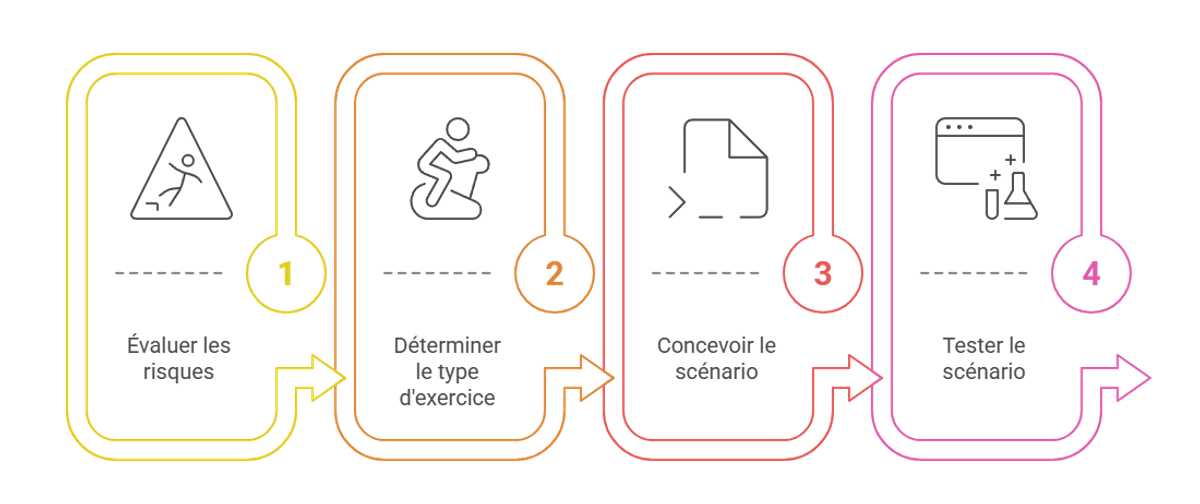
It is essential to determine a scenario that will help achieve the set goals.
- Assess the risks. You must assess the risks associated with the building or area you plan to evacuate. This could include multiple factors (the presence of stairs or elevators, obstacles, the amount of smoke you can expect...). This assessment will allow you to reflect the real conditions in which an emergency situation could arise.
- Determine the type of drill in line with the predefined goals. Full drills or partial drills can be carried out, focusing on specific areas of the building. Along these lines, the choice of drill type will depend on the goals and risks associated with your activity.
- Design the scenario. The information collected beforehand makes it possible to design a scenario for your evacuation drill. It must be realistic and reflect the risks associated with the building or area. It is also important to determine who will be responsible for what during the drill. For example, you can designate people to help people with reduced mobility.
- Test the scenario. Before carrying out the evacuation drill, it is important to test the scenario to make sure it works as expected. This will allow you to identify potential issues and correct them before the actual drill.
Define the location, date, and the people involved for a successful evacuation drill
It is crucial to define the location, date, and people involved when planning an emergency evacuation drill. First of all, it is important to choose a location that presents potential risks for occupants, so they can learn to deal with these situations. The date must be set according to the working hours and the habits of the occupants. Finally, it is essential to identify the people involved, such as the building occupants and the staff members who will oversee the drill.
Carry out the drill
Now it's time for the full-scale drill!
Observe the actions and reactions of participants
Observing the actions and reactions of participants during a fire evacuation drill is essential to assess the effectiveness of the drill. This is done to improve the safety of occupants in the event of a real emergency situation. It is necessary to assess their ability to follow safety instructions and to evacuate the building quickly and efficiently. It is also important to note the areas where slowdowns or blockages occur, as this can help identify design issues or obstacles to evacuation. The actions of participants must also be reviewed, noting those who followed safety procedures and those who made risky or careless decisions.
Review the evacuation drill
After the drill, it is essential to gather feedback and observations from participants about the experience. This can provide valuable insight into the areas that need improvement. Participant feedback should be used to make improvements to the drill and the evacuation strategy. Our CountAct solution automatically drafts your emergency evacuation report and review. Indicators of your crisis management are generated to improve your internal process.
Implement corrective actions.
It is important to define and implement corrective actions after an emergency evacuation. This helps build strong improvements as part of a safety culture approach. To do this, we recommend setting up a working team on the subject. It is essential to define a follow-up schedule for corrective actions. Our CountAct solution is the first digital solution that centralizes and tracks your actions and reports related to your emergency evacuations.
Ready to run your next evacuation drill?
Put these best practices into action with tools designed to plan, execute, and review your evacuation drills efficiently.
SécuQuiz
Test your knowledge
Question 1 sur 5
The French Labor Code requires companies to carry out two evacuation drills per year.
Sources & references
- The French Labor Code requires companies to carry out two evacuation drills — www.legifrance.gouv.fr
Frequently asked questions
Tom BasinStrategic Partnerships Manager
Holding a Master's degree in risk prevention, Tom Basin serves as Partnerships Manager at CountAct, contributing to the development and rollout of the first turnkey crisis management support solution, with the aim of putting security back at the heart of businesses. His experience, along with his training at the Master's level and at the Institut national des hautes études de la sécurité et de la justice, gives him a broad perspective on security and crisis management.