
Fire drill scenario in 2026
Companies are required to conduct two evacuation drills per year to comply with the Labor Code. In an emergency, it is crucial to evacuate all occupants of the buildings concerned quickly and efficiently. Evacuation drills are therefore essential for learning the right practices needed for a successful evacuation. Defining a good fire drill scenario is essential so that the system in place is resilient and ready for anything, since a crisis, as its name suggests, is an unforeseen event. So don't hesitate to show creativity in preparing it.
How do you organize a fire evacuation drill?
For a drill to go as smoothly as possible, it is first necessary for the evacuation instructions to be clearto employees and everyone on site. This means evacuating by:
- Closing doors and windows
- Paying particular attention to disabled or injured people
- Following the instructions of evacuation officers: evacuation wardens and coordinators (first aiders or SSIAP fire safety officers)
- Heading toward the emergency exits following the signage. (signage sign image)
- Using the stairs and not the elevators
During a fire evacuation, elevators must never be used: they can stop working, trap occupants between floors, or open directly onto smoke and flames. Always use the stairs and follow the signage toward the emergency exits.
- Joining the nearest assembly point
- Carrying out a headcount and quickly notifying the coordinator if someone is missing
- Waiting for the coordinator's approval before returning to their workstation
What is the most relevant fire drill scenario?
A SIMPLE SCENARIO This type of fire evacuation drill scenario is easy to deploy. Such as: Simulating an injured person with smoke escaping on a floor. This scenario is very common and makes it possible to check compliance with a procedure for evacuating an injured person. It also allows all staff to be tested on their responsiveness. This type of scenario is not the most recommended. Indeed, it is not representative enough of a real panic situation for employees. A COMPLEX SCENARIO We could imagine a slightly more complex fire evacuation drill scenario. Such as: Accident with pollution The objective is to assess employees' reaction to a complex situation involving an accident and pollution. The proposed scenario involves a refueling tank overturned under a power line on a very hot day. The tanks are leaking, spilling hydrocarbons onto the track and into the ditch. The tanker contains three compartments: off-road diesel, diesel, and gasoline. In addition, a person is injured and unconscious in the vehicle. The site manager and some members of the crisis unit are not present on site and cannot be reached by phone. This type of exercise allows you to test the resilience of your organization in a more complex way. With these 2 scenario ideas, feel free to imagine a mix of the two. At CountAct we can help you carry out your fire evacuation drills and scenarios, or others.
Both of this year's drills, already scripted
Don't start your next fire drill from a blank page · Three ready-to-run scenarios, from simple to nasty
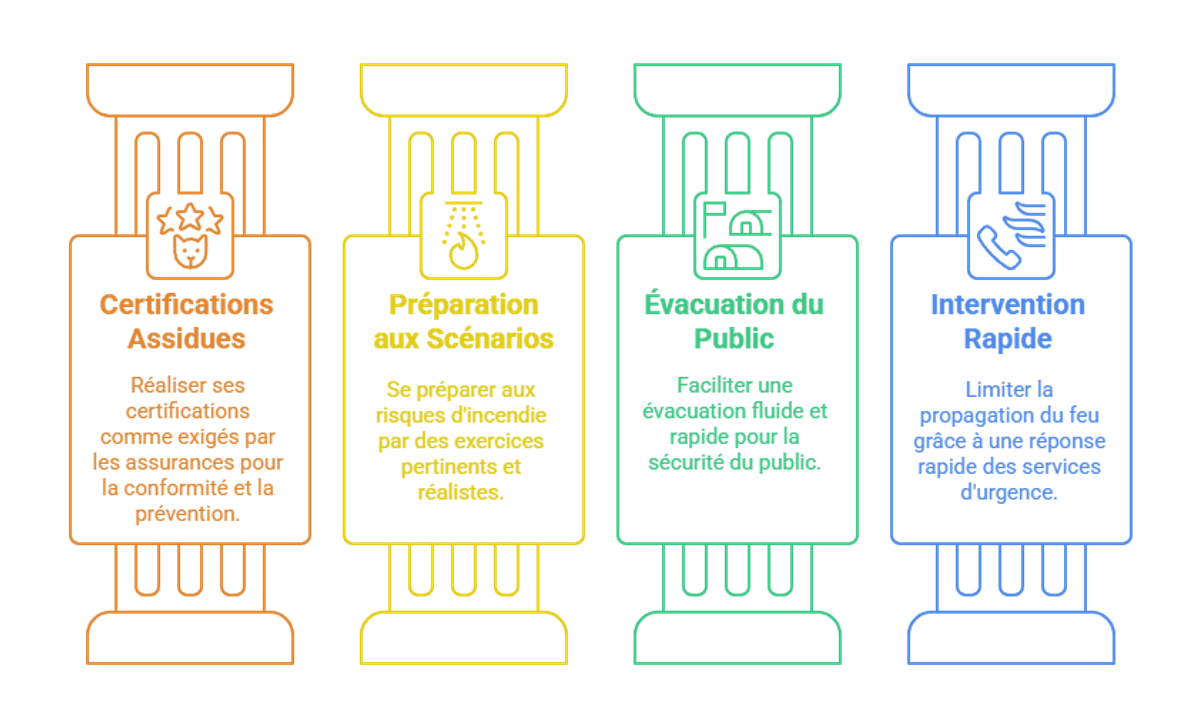
What are the 4 main principles of fire prevention?
The 4 main principles of fire prevention are as follows:
How does fire safety training take place?
For the fire drill scenario to be relevant, it is necessary to ensure that all employees are properly trained. To this end, fire safety training is conducted, covering 7 steps:
1 / Introduction to fundamental safety principles: Namely prevention, protection, and evacuation. This introduction is accompanied by definitions of key safety-related terms, as well as practical examples illustrating the principles presented. Finally, this program also covers everyone's professional responsibilities regarding safety.
2/ An overview of regulations: This covers the key points of the regulatory texts applicable to the establishment. As well as their location within the facility concerned. 3/ Fire prevention and firefighting equipment: Fire alarm systems and internal and external alert procedures in the event of a fire. As well as the use of extinguishing agents and the various means of fire extinguishing. In addition, it will be necessary to develop the ability to locate fire prevention and forecasting resources within the establishment.
4/ Study of evacuation and security plans: A reminder of the safety instructions applicable within the establishment. Then a clarification of everyone's roles during an evacuation, with the implementation of effective organization and management of on-site evacuation in an emergency. Along with the identification of risks specific to the establishment. Finally, a reminder of the procedures to follow to respond correctly to a burned and/or intoxicated victim.
5/ Types of fire: First, an introduction to the fire triangle, combustion, and the principles of fire spread. Then, the distinction between the different fire classes. Finally, an identification of the causes and consequences of a fire. As well as the attitudes to adopt when a fire breaks out.
6/ Types of fire extinguishers: In this section, we present the different types of fire extinguishers and their specific operation. As well as the actions to be taken and followed.
7/ Practical case of using a fire extinguisher: During this section, a fire extinguisher is used (with trainees if possible) to observe the effect of extinguishing agents on a real fire.
What are the regulations on fire evacuation drills and scenarios?
Several articles of the Labor Code concern the obligation to carry out 2 drills per year. Other articles of the Labor Code also require training for staff and on-site safety officers. Here they are: In France, 'Article R4227-28 of the Labor Codestipulates that a company must carry out at least two fire evacuation drills per year, with employees actually present at the workplace, in order to verify that the safety measures are effective and that employees know how to react in an emergency. These drills must be recorded in the safety register and the results must be communicated to the Social and Economic Committee (CSE) or, failing that, to the employees. Article R4227-39 of the Labor Code also states that: "Evacuation drills must be organized and repeated at least every six months in establishments employing workers. These drills are intended to check the signage, arrangements, evacuation and assembly times, as well as the proper functioning of the installations and safety equipment. Instructions are established and posted at the workplace for the different types of alerts and for staff evacuation." Article R4141-17 of the Labor Code concerns staff fire safety training. It provides that the employer must implement practical and appropriate fire safety training for workers, adapted to their activity and enabling them to carry out an evacuation under the best possible conditions. This training is renewed periodically whenever necessary due to changes in the company's organization, work equipment, or premises. Article R4141-20 of the Labor Code concerns the training of staff members responsible for fire prevention and firefighting. According to this article, these members must receive training suited to their duties and to the size and nature of the company. This training must enable them to know the principles of fire prevention, the means of firefighting, and the instructions to follow in the event of a fire. It must also enable them to operate firefighting equipment, such as fire extinguishers.
How do you write a report following a fire evacuation?
Adopt now the CountAct solution, which automatically drafts your report following a fire. It is important to note that writing a report after a fire can vary depending on the specifics of each situation. The report must be precise, clear, and detailed to allow for a complete analysis of the incident and an accurate assessment of the measures to be taken to prevent further fires. Here is a standard template for writing a report after a fire:
Stop writing evacuation reports by hand
CountAct automatically generates your fire evacuation report, ready to file, right after the drill.
- The date, time, and location of the fire.
- The probable cause of the fire.
- A description of the material and human damage caused by the fire.
- The actions taken to extinguish the fire.
- The resources mobilized to fight the fire (human resources, equipment, etc.).
- Any collateral damage caused by the fire (disruption of economic activity, environmental impact, etc.).
- The measures taken to prevent the fire from happening again.
- Recommendations for improving fire safety in the company or establishment concerned.
- The conclusions of the report.
If you would like report templates, we have some available and can provide them to you. Write us an email directly at: countact@countact.Fr You now have the main guidelines for creating your fire drill scenario. To bring yourself into compliance on this subject, feel free to contact us. We will work alongside you to prepare an appropriate scenario, and the CountAct solution will ensure your compliance and that all staff are ready to evacuate at any time.
SécuQuiz
Test your knowledge: Fire evacuation drills
Question 1 sur 5
How many fire evacuation drills must companies conduct per year according to the Labor Code?
Sources & references
- 'Article R4227-28 of the Labor Code — code.travail.gouv.fr
- R4227-39 of the Labor Code — code.travail.gouv.fr
- R4141-17 of the Labor Code — code.travail.gouv.fr
- R4141-20 of the Labor Code — code.travail.gouv.fr
Frequently asked questions
Tom BasinStrategic Partnerships Manager
Holding a Master's degree in risk prevention, Tom Basin serves as Partnerships Manager at CountAct, contributing to the development and rollout of the first turnkey crisis management support solution, with the aim of putting security back at the heart of businesses. His experience, along with his training at the Master's level and at the Institut national des hautes études de la sécurité et de la justice, gives him a broad perspective on security and crisis management.