
The clarification
What is a "levée de doute" (alert verification)?
In a crisis situation, it is essential to be able to safely evacuate the people present on a site. Alert verification is the first step that must not be missed during an incident in a company or an establishment open to the public. Indeed, this step is essential. The task is crucial because the stakeholders in the evacuation process must be competent and trained. The goal is to prevent a disaster from occurring or worsening. In this article, we will address several points:
- What is an alert verification?
- Why carry out an alert verification and what are the different types?
- Who carries out the alert verification?
- What skills are required for someone performing alert verification?
- What regulations apply to alert verification?
What is an alert verification?
Alert verification takes place after an alert is triggered, indicating an anomaly or an urgent issue to be addressed. Indeed, it consists of verifying the origin of this alert. Thus, an entire process is set in motion to analyze and monitor the alert in real time. Depending on the company or establishment, the process may vary, but alert verification always relates to the same principle of monitoring an alert. Indeed, we will come back to this later in a future article, but there are several types of alert triggers (manual, automatic, etc.). Once this alert is triggered, alert verification comes into play. There are 2 types of alert verification:
- First, the alert verification that decides whether to trigger an evacuation depending on whether the situation is under control or not
- But also, the alert verification carried out after the evacuation has been triggered, in order to assess the ongoing incident
In order to avoid unnecessary calls, the authorities and emergency services have made this alert verification mandatory. Indeed, if the authorities consider your call unjustified, they may issue you a €450 fine. Thus, triggering the emergency evacuation of buildings and requesting the intervention of emergency services is based on concrete evidence. Typically, a fire safety system (SSI) with a triggered sensor, videos, photographs, a break-in, or a malicious act.
Calling emergency services without first verifying the alert can lead to unnecessary interventions, which is costly for public authorities. This is why regulations now make alert verification mandatory before contacting the police or fire brigade for many types of sites.
Why carry out an alert verification and what are the different types?
As mentioned in the previous paragraph, alert verification is carried out as soon as an alert that may require an evacuation has been raised. Thus, it is carried out as soon as a trigger is activated or a signal is given. There are 2 types of alert verification depending on the security system in place within the company or establishment:
- First, the alert verification that decides whether to trigger an evacuation. Indeed, this determines whether the situation is under control or not. By passing this information on to the Crisis Unit (made up of the managers), the latter decides whether or not to evacuate everyone. This alert verification often has to be carried out within a specific timeframe, since alarms are triggered automatically 3-5 minutes after the alert is raised. This is often referred to as verifying a False Positive.
- The second, more general type of alert verification takes place after the evacuation has been triggered and the alarm has sounded, in order to assess the ongoing incident and report it to the crisis unit, which manages the emergency evacuation from outside.
Ultimately, these two types of alert verification, whether for a fire or not, help establish tangible evidence regarding an incident that has occurred.
Who carries out the alert verification?
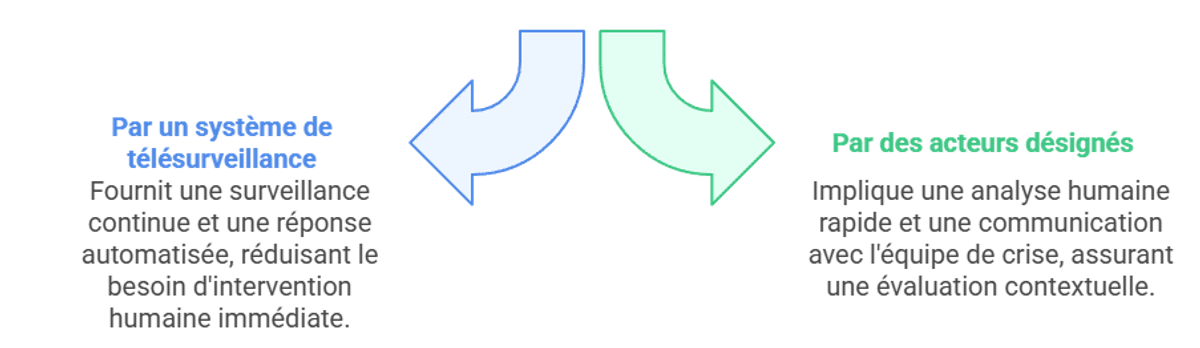
The alert verification is carried out either by:
What skills are required for someone performing alert verification?
It is essential for the person carrying out the alert verification to be able to keep a cool head during a crisis period that may be encountered at the scene of an incident. They must avoid spreading panic so as not to worsen the situation, and must make decisions regarding stressful and anxiety-inducing situations. Thus, they must have a strong sense of responsibility and be a good communicator.
What regulations apply to alert verification?
As mentioned above, in order to provide tangible information requiring the intervention of law enforcement, alert verification has been made legally mandatory so as not to deploy major response resources unnecessarily. Indeed, Article L613-6 of the French Internal Security Code states that it involves "a set of checks […] of the consistency of evidence suggesting the commission of a flagrant crime or offense involving movable or immovable property." As a reminder, if the authorities consider your call unjustified, they may issue you a €450 fine.
The other stakeholders in evacuation…
You now know what an alert verification is. We therefore invite you to read our article on security stakeholders and on first responders if you haven't already. These articles will help you further your knowledge of the important roles involved in a crisis situation. To discuss alert verification and any other security topic further, CountAct us!
Need a reliable alert verification service?
Our teams can help you set up an effective alert verification process tailored to your site's security requirements.
SécuQuiz
Test your knowledge
Question 1 sur 5
What is the main purpose of an "alert verification" (levée de doute)?
Sources & references
- a €450 fine. — www.prefecturedepolice.interieur.gouv.fr
- stressful and anxiety-inducing situations — www.ctif.org
Frequently asked questions
Tom BasinStrategic Partnerships Manager
Holding a Master's degree in risk prevention, Tom Basin serves as Partnerships Manager at CountAct, contributing to the development and rollout of the first turnkey crisis management support solution, with the aim of putting security back at the heart of businesses. His experience, along with his training at the Master's level and at the Institut national des hautes études de la sécurité et de la justice, gives him a broad perspective on security and crisis management.