
Fire Permit at Work: Obligations, Content, and Liability
What is a fire permit, and when is it mandatory?
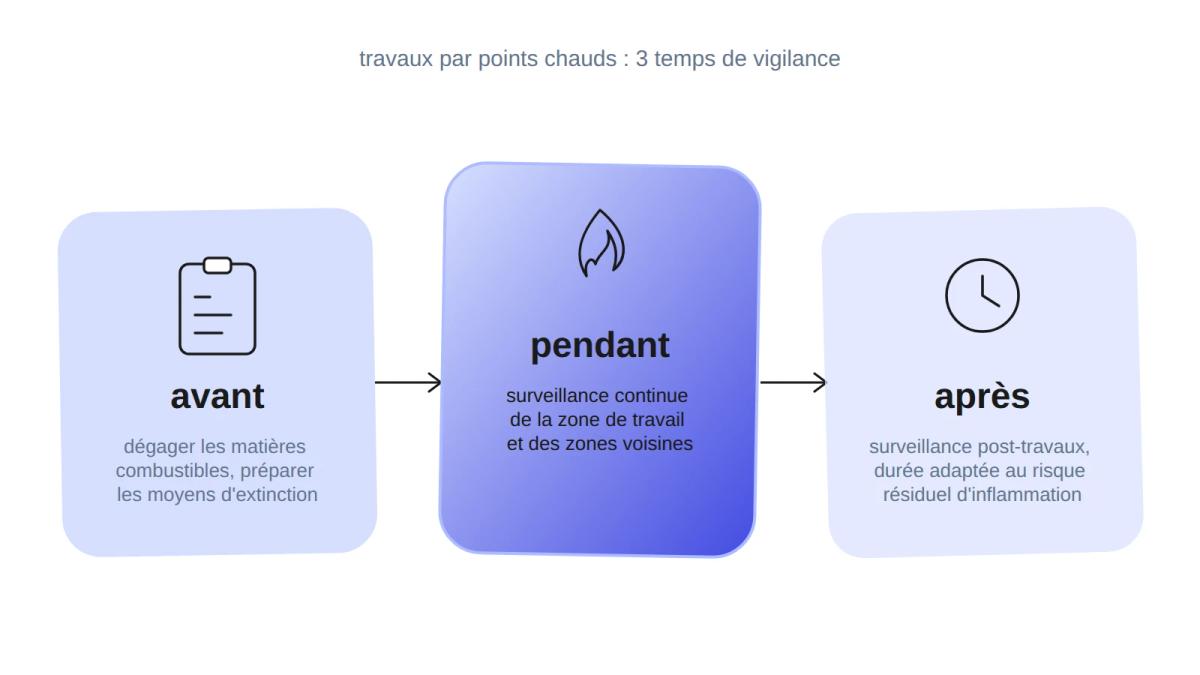
A fire permit formalizes the prevention measures to follow before, during, and after hot work. This covers welding, cutting, grinding, brazing, or any use of a flame or ignition source. The Order of March 19, 1993 is issued under Article R.4512-7 of the Labour Code. It explicitly lists oxyacetylene welding work “requiring the use of a fire permit” among its dangerous work categories.
As soon as an external company carries out this type of work, or its work represents at least 400 hours over twelve months, a written prevention plan becomes mandatory. The fire permit is annexed to it for the hot-work portion: it does not replace the prevention plan, it complements it.
The prevention plan organizes overall coordination between the user company and the external company for the whole duration of an intervention. The fire permit is an operational document issued for each hot-work session: it is added to the prevention plan when this type of work is involved, without replacing it.
For more on this framework document, see our article on the prevention plan and external actions.
Who must issue the fire permit?
The fire permit is issued by the head of the user company (the operator of the site where the work takes place) or a qualified safety representative. It is issued in coordination with the company or team carrying out the work, whether external or internal. This responsibility falls under the employer's general safety obligation, which requires taking the necessary measures to protect workers' physical health.
The strict regulatory framework of the 1993 Order targets coordination with an external company. But the INRS recommends the same documentation rigor for hot work carried out in-house, whenever it presents a comparable fire risk: the fire permit remains, in that case, a prevention best practice to formalize within your safety approach.
What must a compliant fire permit contain?
According to the INRS reference brochure (ED 6030), a fire permit must clearly identify who is working, where, when, how, and with what precautions. It brings together:
- Identification of the user company and of the company or team carrying out the work
- The precise work location and its description: nature of the operation, equipment used
- The planned date and schedule of the intervention
- Prevention measures to follow before work starts: clearing combustible materials, protecting nearby installations, extinguishing equipment nearby
- Measures to observe during the work
- The monitoring period to maintain after work stops, adapted to the residual risk
- Signatures of the user company, the intervening company, and, where applicable, the safety officer
Fire permit and safety register: where to keep the record?
For an ERP subject to the safety register, the record of issued fire permits belongs in the work log kept in the safety register. This ongoing traceability is also something insurers examine closely when negotiating or renewing a commercial property damage insurance contract.

Centralize the tracking of your fire permits
CompliAssist tracks your fire permits, your safety register, and your prevention plans in a single dashboard, with ScoreRisk as your compliance indicator.
Who monitors the site during and after the work?
On site, the monitoring required by the fire permit is often carried out by the personnel named in the document, supported by the First Responder, trained to act on an early-stage fire and to check an alert before it escalates.
A smoldering fire can break out several hours after work stops. The monitoring period stated on the fire permit must be fully observed, even when the intervention appears to have ended without incident.
What is a company's liability without a fire permit in case of an accident?
The absence of a formal fire permit, during hot work covered by the Order of March 19, 1993, can be flagged as a failure to meet expected prevention measures. It may engage the employer's liability under their safety obligation, with consequences that depend on each situation: observations, formal notice, or stricter measures in case of a serious failure.
This article presents the general framework applicable to hot work. Assessing your specific situation (exact nature of the work, status of the intervening company, insurance coverage) should be validated with a lawyer, your inspection body, or your insurer.
SécuQuiz
Test your knowledge of the fire permit
Question 1 sur 4
According to the Order of March 19, 1993, which work explicitly requires a fire permit?
Sources & references
- Article R.4512-7 - Labour Code — Légifrance
- Article 1 - Order of March 19, 1993 (list of dangerous work) — Légifrance
- Fire Permit - Brochure ED 6030 — INRS
- Article L.4121-1 - Labour Code (employer's safety obligation) — Légifrance
Frequently asked questions
Tom BasinStrategic Partnerships Manager
Holding a Master's degree in risk prevention, Tom Basin serves as Partnerships Manager at CountAct, contributing to the development and rollout of the first turnkey crisis management support solution, with the aim of putting security back at the heart of businesses. His experience, along with his training at the Master's level and at the Institut national des hautes études de la sécurité et de la justice, gives him a broad perspective on security and crisis management.