
Multi-Year Work Plan (PPT) in Condominiums: What's Mandatory Since 2025
An obligation that now applies to every condominium
The multi-year work plan (plan pluriannuel de travaux, or PPT) is a document that lists and schedules, over ten years, the work needed to preserve a condominium building. It became a legal requirement under the Climate and Resilience law of August 22, 2021, rolled out progressively based on the size of each condominium.
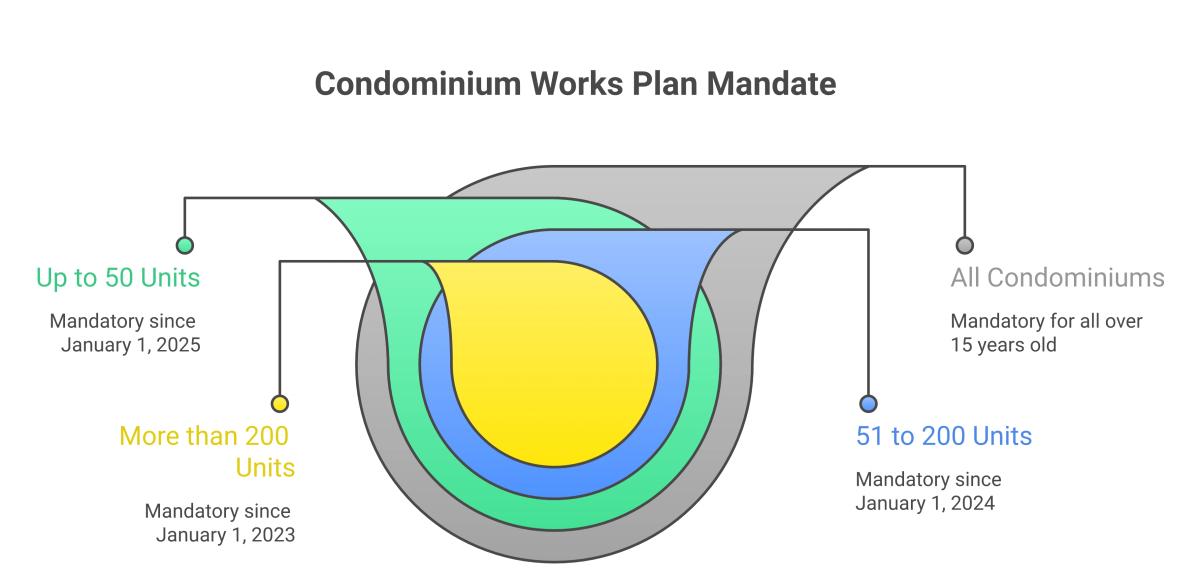
This obligation didn't apply overnight: it was rolled out in stages, starting January 1, 2023 for condominiums with more than 200 units, then January 1, 2024 for those with 51 to 200 units, and finally January 1, 2025 for every condominium, regardless of size. The smallest condominiums are therefore the last ones affected, and many have not yet come into compliance.
The PPT only applies to buildings with total or partial residential use whose construction work was completed more than fifteen years ago. Check with your syndic whether your condominium falls within this scope and by which deadline it needed to comply.
What the multi-year work plan must contain
Article 14-2 of the law of July 10, 1965 sets the minimum content of the project: a list of work needed to preserve the building, protect occupant health and safety, improve energy efficiency, and reduce greenhouse gas emissions, a cost estimate, a priority ranking, and a schedule for the next ten years.
The project must be entrusted to a professional with competencies and independence guarantees with respect to the syndic, energy suppliers, and firms likely to work on the building, set by Decree No. 2022-663 of April 25, 2022.
If the adopted multi-year work plan is not submitted within one month of a request from the administrative authority, the mayor or the prefect can draw it up, or have it drawn up, at the expense of the co-owners' syndicate.
The technical global diagnosis (DTG): how it connects to the PPT
The technical global diagnosis (diagnostic technique global, or DTG) has existed since the ALUR law of March 24, 2014. Framed by Article L731-1 of the French Construction and Housing Code, it provides a broader assessment than the PPT: an analysis of the apparent condition of common areas and equipment, the syndicate's situation regarding its legal and regulatory obligations, possible improvements in technical and asset management, and an energy performance diagnosis of the building.
The DTG and the PPT are distinct but connected: a DTG that concludes no work is needed within ten years exempts the condominium from the obligation to draw up a multi-year work plan.
This logic of a technical document kept up to date and available for consultation isn't unique to condominiums. In establishments open to the public or to workers, the safety register plays a comparable role: centralizing completed checks and works over time, instead of reconstructing them after the fact.

Centralize your condominium's compliance tracking
CompliAssist centralizes the tracking of your multi-year work plan, your technical global diagnosis, and your compliance deadlines: the documented proof to present at a general assembly or to the administrative authority.
Documenting compliance over time: why it changes the picture
Prioritizing work over ten years first requires properly identifying the major risks specific to the building (structure, fire safety, elevators, utility networks) before ranking them in the plan, rather than handling emergencies one general assembly at a time.
Condominiums: two ways to approach the PPT obligation
| Structured tracking (PPT, DTG) | Informal tracking, no documented plan | |
|---|---|---|
| Meeting the legal deadline (January 1, 2025) | Anticipated and documented in advance | Discovered late, under pressure |
| Responding to a request from the administrative authority | Plan already available and ready to submit | Risk of the plan being drawn up at the syndicate's expense |
| Prioritizing work over 10 years | Costed, ranked schedule | One-off decisions made at general assemblies |
| Connection with the DTG | Cross-tracked, exemption identified where applicable | Duplication or a missing document |
This principle of a living document, updated as the building evolves, echoes the DUERP in businesses: a tool that only has value if it's genuinely kept up to date, not filled in once to check an administrative box.
This content presents the general framework of the multi-year work plan and the technical global diagnosis. Only your syndic, a qualified professional, or a lawyer specialized in condominium law can precisely assess your building's situation.
SécuQuiz
Test your knowledge of the multi-year work plan
Question 1 sur 4
Since what date has the multi-year work plan (PPT) been mandatory for every condominium, regardless of its number of units?
Sources & references
- Article 14-2 - Law No. 65-557 of 10 July 1965 on the status of condominiums — Légifrance
- Multi-year work plan (PPT) implemented in condominiums — Service-public.fr
- Article L731-1 - French Construction and Housing Code (technical global diagnosis) — Légifrance
- Decree No. 2022-663 of 25 April 2022 on the competencies and guarantees required for professionals drawing up the multi-year work plan — Légifrance
Frequently asked questions
Tom BasinStrategic Partnerships Manager
Holding a Master's degree in risk prevention, Tom Basin serves as Partnerships Manager at CountAct, contributing to the development and rollout of the first turnkey crisis management support solution, with the aim of putting security back at the heart of businesses. His experience, along with his training at the Master's level and at the Institut national des hautes études de la sécurité et de la justice, gives him a broad perspective on security and crisis management.